Activation of Beta-Catenin Signaling in CD133-Positive Dermal Papilla Cells Drives Postnatal Hair Growth

    July 2016 in “ PLOS ONE
    Linli Zhou, Mingang Xu, Yunxia Yang, Kun Yang, R. Randall Wickett, Thomas Andl, Sarah E. Millar, Yuhang Zhang
    Image of study
    TLDR Activating β-catenin in certain skin cells speeds up hair growth in mice.
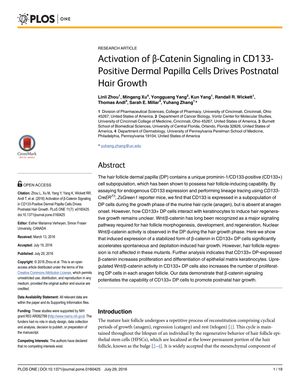
    The study explored the effect of β-catenin signaling activation in CD133-positive dermal papilla (DP) cells on hair growth in mice. It was found that activating β-catenin in these cells significantly accelerated hair growth without affecting the regression phase of the hair cycle. The activation led to increased proliferation and differentiation of epithelial matrix keratinocytes and a larger population of proliferating DP cells. The research suggests that β-catenin signaling could be a potential therapeutic target for hair growth disorders. Although the study used a tri-transgenic mouse model, the specific number of mice used was not mentioned in the summary. The findings indicate that CD133+ DP cells contribute to hair growth after the onset of the anagen phase and that β-catenin signaling promotes hair follicle differentiation and growth during the early-to-mid anagen stages. However, the secreted factors involved in this process were not fully characterized and require further investigation.

    Discuss this study in the Community →

    Research cited in this study

    10 / 10 results

    Related Community Posts Join

    6 / 107 results

      community Hair theory Scar tissue and Verteporfin

      in Chat  26 upvotes 1 year ago
      A user suggests that deeper microneedling with Verteporfin injections might help regrow hair in areas with scar tissue, alongside a DHT blocker. Another user explains that hair loss might be due to reduced Wnt/β-Catenin signaling and suggests that treatments like Minoxidil, Finasteride, and microneedling could potentially reverse it.

      community Better Than Minoxidil? Topical Sodium Valproate

      in Research/Science  51 upvotes 1 year ago
      Topical sodium valproate may promote hair growth by inhibiting GSK3β, allowing beta-catenin to proliferate, but it has potential side effects and requires more research. The conversation also mentions skepticism about a product called Vdphlo1, which includes sodium valproate and other ingredients.

      community Does melatonin dissolve in isopropyl alcohol

      in Technology  7 upvotes 3 years ago
      The conversation discusses making a topical melatonin solution for hair loss treatment, questioning if isopropyl alcohol can dissolve melatonin. Melatonin is soluble in lipids and alcohol, but it's unstable and should be mixed fresh regularly; it may help hair growth by affecting certain cellular signaling pathways and has anti-androgenic effects.

    Related Research

    6 / 6 results