TLDR Bimekizumab effectively treats scalp cellulitis and improves quality of life.
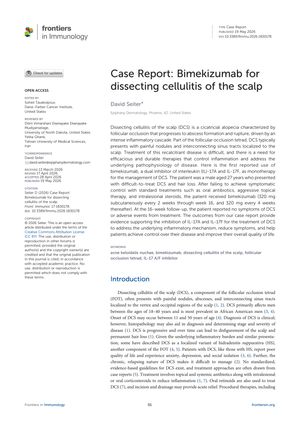
This case report documents the first use of bimekizumab, a dual inhibitor of IL-17A and IL-17F, as monotherapy for dissecting cellulitis of the scalp (DCS), a challenging form of cicatricial alopecia. A 27-year-old male with difficult-to-treat DCS and hair loss, unresponsive to standard treatments, was administered bimekizumab (320 mg subcutaneously every 2 weeks for 16 weeks, then every 4 weeks). At the 16-week follow-up, the patient experienced no symptoms or adverse events, suggesting that bimekizumab effectively addresses the inflammatory mechanism of DCS, reduces symptoms, and improves quality of life.
Dissecting cellulitis of the scalp mainly affects Black males and requires early diagnosis and management.
 3 citations
,
June 2025 in “Archives of Dermatological Research”
3 citations
,
June 2025 in “Archives of Dermatological Research” Biologics and JAK inhibitors may improve treatment for scarring alopecias.
 May 2025 in “Orphanet Journal of Rare Diseases”
 TNF-α blockers and IL inhibitors improve symptoms in most patients with severe scalp condition, but more research is needed.
 May 2025 in “Journal of Inflammation Research”
 A combination of ixekizumab and tofacitinib successfully treated severe scalp cellulitis, leading to hair regrowth.
 1 citations
,
September 2023 in “Dermatology and therapy”
1 citations
,
September 2023 in “Dermatology and therapy” More research is needed to find the best treatment for dissecting cellulitis of the scalp.
 144 citations
,
November 2020 in “Frontiers in immunology”
144 citations
,
November 2020 in “Frontiers in immunology” Targeting the IL-23/IL-17 pathway effectively treats several inflammatory skin diseases.
 59 citations
,
December 2016 in “Clinical, Cosmetic and Investigational Dermatology”
59 citations
,
December 2016 in “Clinical, Cosmetic and Investigational Dermatology” Acne keloidalis nuchae is a tough-to-treat condition that greatly affects quality of life, especially in men of African descent.