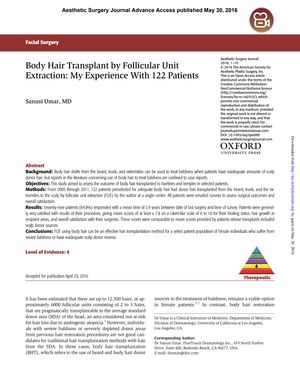
Body Hair Transplant by Follicular Unit Extraction: My Experience With 122 Patients

    May 2016 in “ Aesthetic Surgery Journal
    Sanusi Umar
    Image of study
    TLDR Body hair transplantation is an effective method for restoring hair in people with severe baldness and limited scalp donor hair.
    In the study involving 122 male patients who underwent body hair transplantation (BHT) to the scalp using Follicular Unit Extraction (FUE) from 2005 to 2011, Dr. Sanusi Umar found that BHT is an effective hair restoration method for those with severe baldness or inadequate scalp donor hair. The patients, with a mean age of 42.7 years, were preselected for adequate body hair and primarily used beard hair as the donor source. The mean graft count was 4346, with 75% being BHT grafts. Of the 79 patients who responded to a survey, satisfaction scores were high, averaging above 7.8 out of 10 for healing, hair growth, and overall satisfaction, despite the procedure being longer, more costly, and requiring higher surgical skill. The mean follow-up time was 2.9 years, and the graft take rate for BHT was 75%-80%, compared to 95% for scalp donor hair. The study also acknowledges limitations such as response bias and the absence of blinded third-party assessments. The author holds a patent for the technologies used and received no financial support for the research.

    Discuss this study in the Community →

    Research cited in this study

    14 / 14 results

    Related Community Posts Join

    6 / 1000+ results

      community Verteporfin and Microneedling

      in Treatments 1 year ago
      Clinical studies by Dr. Barghouthi and Dr. Bloxham indicate that Verteporfin, when used with FUE and FUT hair transplantation methods, shows promise in hair follicle regeneration and minimal scarring due to its ability to inhibit Yes-associated protein (YAP). Microneedling at depths of 3-3.5mm, combined with Verteporfin, could potentially reactivate dormant follicles, although the optimal dosage and application method are still under investigation. Concerns remain about the DHT sensitivity of regenerated follicles, highlighting the need for further research to optimize trauma levels and Verteporfin concentrations to achieve effective and scar-free hair regeneration.

      community Occipitalis Muscle Tension Theory

      in Treatment  7 upvotes 1 week ago
      Scalp tension from the occipitalis muscle is theorized to contribute to hair loss, but most believe DHT and genetics are the main causes. Treatments like finasteride and minoxidil are considered more effective than addressing scalp tension.
      If You Have DUPA, PLEASE READ THIS: Everyone Should Be Scalp Biopsied

      community If You Have DUPA, PLEASE READ THIS: Everyone Should Be Scalp Biopsied

      in Research  830 upvotes 1 year ago
      Scalp biopsies are crucial for diagnosing hair loss conditions like Diffuse Unpatterned Alopecia (DUPA) and retrograde hair loss, as treatments like finasteride and dutasteride may not be effective if other conditions are present. Combining PPAR-GAMMA agonists with retinoids could improve treatments for conditions like Lichen Planopilaris.

      community A Theory on Why Microneedling Works

       172 upvotes 6 years ago
      Microneedling may enhance hair regrowth by transferring stem cells to dormant follicles, improving the effects of minoxidil. Users discuss using microneedling with needle lengths around 1.5mm to stimulate hair growth.

      community 10 Days Post-Op: Hair Transplant Results and Experience

      in Progress Pictures  505 upvotes 1 year ago
      A user shared their positive experience with a hair transplant at Dr. Resul Yaman Hair Clinic in Istanbul, including before and after photos. They are considering taking oral Minoxidil post-operation but are avoiding Finasteride due to side effects.

    Related Research

    6 / 6 results