Dermal Adipose Tissue in Hair Follicle Cycling: Possible Applications in Alopecia

    April 2017 in “ PubMed
    Uwe Wollina, Naser M Abdel, Ilja L. Kruglikov
    Image of study
    TLDR Fat cells near hair follicles may affect hair growth and could help treat baldness.
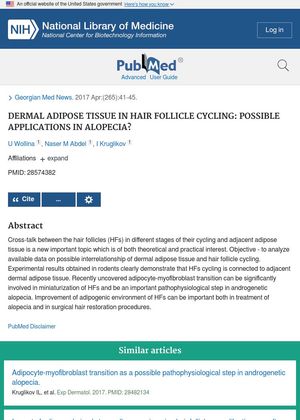
    The 2017 study by U Wollina et al. explored the relationship between dermal adipose tissue and hair follicle cycling, with potential implications for alopecia treatment. The research, conducted on rodents, demonstrated a clear connection between hair follicle cycling and adjacent dermal adipose tissue. The study also highlighted the adipocyte-myofibroblast transition, which could play a significant role in the miniaturization of hair follicles, a key pathophysiological step in androgenetic alopecia. The researchers suggested that improving the adipogenic environment of hair follicles could be beneficial in treating alopecia and enhancing surgical hair restoration procedures.

    Discuss this study in the Community →

    Related Community Posts Join

    6 / 1000+ results

      community Making your own RT1640 in China

      in Research/Science 4 years ago
      RT1640, a combination of cyclosporin A, minoxidil, and RT175, is discussed as a potential treatment for hair regrowth and repigmentation. The unique formulation aims to enhance hair follicle growth and restore hair pigment without the negative side effects of immunosuppressants.

      community Anti-oxidants that reverse hairloss?

      in Research/Science  88 upvotes 5 years ago
      Resveratrol and fisetin, found in red wine and strawberries, may promote hair growth by affecting hair follicle cells. Users discuss various treatments, including natural remedies like saw palmetto and topical applications, with mixed opinions on their effectiveness compared to pharmaceuticals like finasteride.
      If You Have DUPA, PLEASE READ THIS: Everyone Should Be Scalp Biopsied

      community If You Have DUPA, PLEASE READ THIS: Everyone Should Be Scalp Biopsied

      in Research  830 upvotes 1 year ago
      Scalp biopsies are crucial for diagnosing hair loss conditions like Diffuse Unpatterned Alopecia (DUPA) and retrograde hair loss, as treatments like finasteride and dutasteride may not be effective if other conditions are present. Combining PPAR-GAMMA agonists with retinoids could improve treatments for conditions like Lichen Planopilaris.

      community The Real Reason For Hair Loss?

      in Research/Science 1 month ago
      Hair loss is linked to scalp fibrosis and tension, which result from chronic mechanical stress and androgenic signaling. Treatments include blocking androgens with finasteride, promoting hair growth with topical minoxidil, and improving scalp mobility through exercises.

    Similar Research

    5 / 1000+ results