TLDR Ultrasonography in dermatology improves diagnosis and treatment of skin conditions.
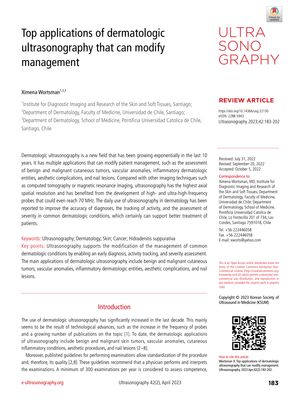
Dermatologic ultrasonography, a rapidly growing field over the past decade, had significant applications in modifying patient management by improving the assessment of various dermatologic conditions, including benign and malignant tumors, vascular anomalies, inflammatory entities, aesthetic complications, and nail lesions. It offered superior axial spatial resolution compared to other imaging techniques, thanks to advancements in high- and ultra-high-frequency probes. The routine use of ultrasonography in dermatology was reported to enhance diagnostic accuracy, track disease activity, and assess severity, thereby supporting improved patient treatment.
 10 citations
,
November 2021 in “Revista médica de Chile”
10 citations
,
November 2021 in “Revista médica de Chile” The guideline helps diagnose and treat hidradenitis suppurativa early to improve patient outcomes.
 22 citations
,
March 2021 in “Journal of Cutaneous Medicine and Surgery”
22 citations
,
March 2021 in “Journal of Cutaneous Medicine and Surgery” Ultrasound is a useful, non-invasive tool in dermatology for diagnosing skin conditions and guiding treatments, but it has some limitations.
 76 citations
,
May 2020 in “Ultraschall in der Medizin - European Journal of Ultrasound”
76 citations
,
May 2020 in “Ultraschall in der Medizin - European Journal of Ultrasound” The EFSUMB created basic guidelines for using ultrasound in skin-related medical practice.
41 citations
,
November 2019 in “Journal of Ultrasound in Medicine” Ultrasound can help detect early signs and severity of hidradenitis suppurativa.
 30 citations
,
June 2015 in “Dermatologic Surgery”
30 citations
,
June 2015 in “Dermatologic Surgery” Ultrasound shows 80% of Hidradenitis Suppurativa patients have abnormal hair tracts that may worsen the condition.
 17 citations
,
June 2014 in “Journal of Ultrasound in Medicine”
17 citations
,
June 2014 in “Journal of Ultrasound in Medicine” Abnormal cuticle and hair shaft medulla cause hair loss in androgenetic alopecia; sonography helps diagnose and manage it.
108 citations
,
October 2005 in “Journal of Ultrasound in Medicine” Ultrasonography improves pilomatricoma diagnosis accuracy.