Dermatological Drugs and Topical Agents

    January 2004 in “ Side effects of drugs annual
    W.M.C. Mulder, M.M.H.M. Meinardi
    Image of study
    TLDR Certain skin drugs and topical agents, including some natural extracts and fragrances, can cause allergic reactions. Some hair dyes and extensions, as well as minoxidil, a hair growth treatment, can also cause allergies. Botulinum toxin A can effectively reduce sweat but may have temporary side effects.
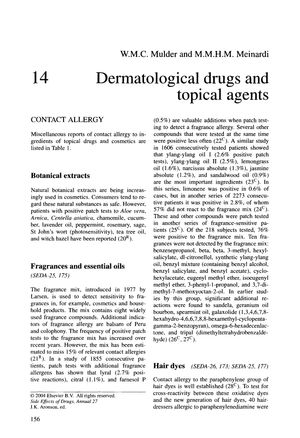
    In 2003, various dermatological drugs and topical agents were studied for their potential to cause allergic reactions. Natural botanical extracts used in cosmetics were found to cause positive patch tests in some patients. A study of 1855 patients identified certain fragrance allergens as valuable for testing fragrance allergies. Another study of 1606 patients found ylang-ylang oil, lemongrass oil, and jasmine absolute to cause positive patch tests. Hair dyes, particularly the paraphenylene group, were established as allergens, but newer dyes did not cause reactions in a study of 40 hairdressers. A 10-year analysis of 73,818 patients showed cases of contact allergy to formaldehyde and MCI/MI, preservatives in cosmetics. Hair bonds and extensions were found to cause severe type I reactions in some patients. Minoxidil, used for hair growth, was found to cause allergic reactions in some patients. A 57-year-old man developed pigmented contact dermatitis after using minoxidil 5% for 2 years, and a 24-year-old woman became sensitized to minoxidil and saw palmetto, a hair loss treatment. A fetus had severe malformations due to maternal minoxidil exposure. Botulinum toxin A was found to be effective in reducing sweat production in patients with axillary hyperhidrosis in a trial involving 145 patients, but some experienced temporary adverse events. Other studies examined the phototoxicity and photosensitization potential of various substances, the risk for hyperlipidemia and metabolic syndrome after hypertriglyceridemia during 13-cis retinoic acid therapy for acne, and the safety and effectiveness of botulinum toxin type A for axillary hyperhidrosis over 16 months.

    Discuss this study in the Community →

    Related Community Posts Join

    6 / 1000+ results

    Similar Research

    5 / 1000+ results
      Dermatological Drugs, Topical Agents, And Cosmetics

      research Dermatological Drugs, Topical Agents, And Cosmetics

      1 citations , January 2005 in “Side effects of drugs annual”
      The document concluded that various dermatological treatments have different effectiveness and side effects, with some causing irritation, allergic reactions, or systemic effects.
      A Decade of Progress in Androgenetic Alopecia Management: Emerging Therapies and Multimodal Strategies

      research A Decade of Progress in Androgenetic Alopecia Management: Emerging Therapies and Multimodal Strategies

      December 2025 in “IP Indian Journal of Clinical and Experimental Dermatology”
      Over the past decade, the management of androgenetic alopecia (AGA) has evolved to include integrated, multimodal strategies that address its multifactorial nature. Traditional therapies like minoxidil and finasteride remain foundational, but combination regimens, including emerging treatments such as topical antiandrogens, JAK inhibitors, and regenerative strategies like platelet-rich plasma (PRP) and stem cell-derived exosomes, show promise. Nutraceuticals, botanical supplements, and cosmeceutical peptides offer supportive benefits, while device-based interventions like low-level laser therapy and microneedling stimulate follicular activity. The treatment paradigm is shifting towards personalized regimens, with future directions focusing on biologics, exosomes, and tissue engineering. Despite promising innovations, long-term efficacy data are limited, and many findings are based on small studies or preclinical research.
      Androgenetic Alopecia: An Evidence-Based Treatment Update

      research Androgenetic Alopecia: An Evidence-Based Treatment Update

      151 citations , May 2014 in “American Journal of Clinical Dermatology”
      Effective treatments for male pattern baldness include oral finasteride and topical minoxidil, while topical minoxidil is best for female pattern baldness.
      Mesococktails and Mesoproducts in Aesthetic Dermatology

      research Mesococktails and Mesoproducts in Aesthetic Dermatology

      11 citations , August 2020 in “Dermatologic therapy”
      The document concludes that mesotherapy can be effective for skin and hair treatments, but more research is needed to confirm its safety and effectiveness.