Diagnostic Modalities in Trichology: An Update

    January 2015 in “ Hair therapy & transplantation
    Yasmeen Jabeen Bhat
    Image of study
    TLDR New hair and scalp disease diagnosis methods are important for correct treatment.
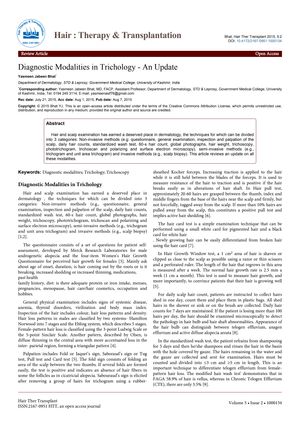
    The article from 2015 reviews diagnostic techniques in trichology, including non-invasive, semi-invasive, and invasive methods. Non-invasive methods range from questionnaires to electron microscopy, while semi-invasive and invasive methods include trichograms and scalp biopsies, respectively. The article highlights the use of trichoscopy, trichometry, and various microscopy techniques for analyzing hair structure and disorders. It also discusses advanced tools like Scanning Electron Microscopy (SEM), Transmission Electron Microscopy, Atomic Force Microscopy, and the "HoVert" technique for scalp biopsies. Direct immunofluorescence is noted for differentiating between primary cicatricial alopecias (PCA), and microarray analysis for distinguishing between similar PCAs. Reflectance Confocal Microscopy (RCM) and Trichoscan are also mentioned as diagnostic tools. These modalities are crucial for accurate diagnosis and treatment monitoring of hair and scalp diseases.

    Discuss this study in the Community →

    Research cited in this study

    16 / 16 results

    Related Community Posts Join

    6 / 77 results

      community 13 days on Ru58841 hair trichoscopy

      in Update  17 upvotes 9 months ago
      The user noticed potential hair growth after 13 days of using RU58841, alongside a regimen of oral minoxidil, finasteride, and topical minoxidil. Others think it's too soon to see results, and some are surprised by the high dosage of oral minoxidil.

      community Predicting Your Hair Loss with a Trichoscopy Report

      in Treatment  7 upvotes 1 year ago
      The conversation discusses the use of trichoscopy to predict hair loss patterns and inform treatment approaches. Treatments mentioned include minoxidil, finasteride, and dutasteride, with varying effectiveness based on gender-specific hair loss patterns.

      community 21m, 2.5 months on 1mg dut & 2.5mg min

      in Progress Pictures  10 upvotes 3 months ago
      A 21-year-old male has been using dutasteride, minoxidil, ketoconazole shampoo, and microneedling for hair loss, with plans to increase minoxidil dosage. He is experiencing no side effects and is planning a trichoscopy to assess hair regrowth.

      community Doctor told me not to take fin.

      in Transplants  16 upvotes 2 days ago
      A doctor advised against taking finasteride after a hair transplant, suggesting the patient had reached their final balding pattern, but many users disagreed, recommending medications like minoxidil and finasteride to prevent further hair loss. The consensus was to seek a second opinion, as the advice seemed financially motivated rather than medically sound.
      21M, Starting to thin. Family history of early balding. Need advice

      community 21M, Starting to thin. Family history of early balding. Need advice

      in General  59 upvotes 23 hours ago
      A 21-year-old with a family history of early balding is advised to see a dermatologist to confirm androgenetic alopecia (AGA) and consider treatments like finasteride or dutasteride to prevent further hair loss, and minoxidil, possibly with tretinoin, to regrow hair. Caution is advised with oral minoxidil, and a cardiologist should be consulted before use.

    Similar Research

    5 / 1000+ results