Health Utility of Facial Angiofibroma Associated with Tuberous Sclerosis Complex
February 2026
TLDR Moderate facial angiofibroma significantly reduces quality of life compared to almost-clear cases, highlighting the benefits of treatment.
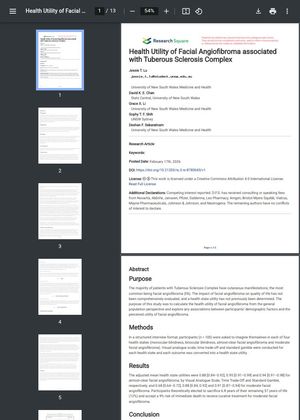
The study assessed the health utility of facial angiofibroma (FA) in Tuberous Sclerosis Complex by evaluating the quality of life impact from a general population perspective. Involving 100 participants, the study used visual analogue scale, time trade-off, and standard gamble methods to determine health state utilities for almost-clear and moderate FA. Results showed adjusted mean utilities of 0.88, 0.95, and 0.94 for almost-clear FA, and 0.68, 0.88, and 0.91 for moderate FA, respectively. Participants indicated a willingness to sacrifice 12% of their remaining life or accept a 9% risk of immediate death for curative treatment of moderate FA. The study concluded that moderate FA significantly reduces quality of life compared to almost-clear FA, emphasizing the benefits of treatment.