TLDR Methotrexate reduced the need for steroids in asthma patients without worsening their condition.
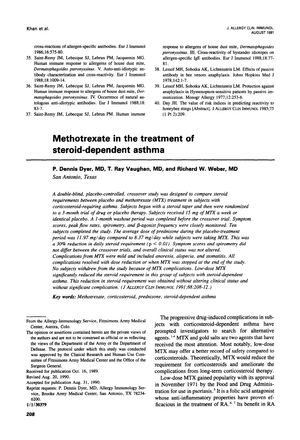
A double-blind, placebo-controlled, crossover study involving 10 subjects with corticosteroid-requiring asthma found that low-dose methotrexate (MTX) significantly reduced the daily steroid requirement by 30% (from 11.97 mg/day to 8.37 mg/day of prednisone, p < 0.01) without altering clinical status. Symptom scores, peak flow rates, and spirometry remained unchanged between the MTX and placebo periods. Mild complications such as anorexia, alopecia, and stomatitis were observed but resolved with dose reduction or discontinuation of MTX. No subjects withdrew due to MTX complications.

November 2019 in “Harper's Textbook of Pediatric Dermatology” The document is a detailed medical reference on skin and genetic disorders.
14 citations
,
January 2017 in “Annals of Dermatology” Low-dose methotrexate effectively regrows hair in many alopecia areata patients but can cause some side effects.
44 citations
,
August 2014 in “Anais brasileiros de dermatologia/Anais Brasileiros de Dermatologia” Methotrexate is a promising and safe treatment for severe alopecia areata, with better results when combined with corticosteroids.
July 2025 in “International Journal of Trichology” Intralesional methotrexate and triamcinolone acetonide are more effective than Vitamin D3 for treating alopecia areata.
October 2023 in “Benha Journal of Applied Sciences” Methotrexate and vitamin D3 are potentially more effective and safer than triamcinolone for treating localized alopecia areata.
15 citations
,
May 2017 in “JEADV. Journal of the European Academy of Dermatology and Venereology/Journal of the European Academy of Dermatology and Venereology” High-dose corticosteroids and methotrexate had a modest effect on severe childhood alopecia, but side effects and relapse were concerns.