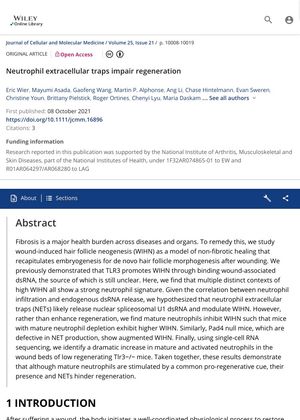
 4 citations
,
October 2021 in “Journal of Cellular and Molecular Medicine”
4 citations
,
October 2021 in “Journal of Cellular and Molecular Medicine” White blood cells and their traps can slow down the process of new hair growth after a wound.
 53 citations
,
April 2021 in “Cell Host & Microbe”
53 citations
,
April 2021 in “Cell Host & Microbe” Skin bacteria, specifically Staphylococcus aureus, help in wound healing and hair growth by using IL-1β signaling. Using antibiotics on skin wounds can slow down this natural healing process.
 47 citations
,
June 2019 in “Nature Communications”
47 citations
,
June 2019 in “Nature Communications” Noncoding dsRNA boosts hair growth by activating TLR3 and increasing retinoic acid.
 37 citations
,
February 2019 in “Experimental Dermatology”
37 citations
,
February 2019 in “Experimental Dermatology” Spiny mice are better at regenerating hair after injury than laboratory mice and could help us understand how to improve human skin repair.
 145 citations
,
November 2018 in “Nature Communications”
145 citations
,
November 2018 in “Nature Communications” The Sonic hedgehog pathway is crucial for new hair growth during mouse skin healing.
 27 citations
,
May 2018 in “Journal of Dermatological Science”
27 citations
,
May 2018 in “Journal of Dermatological Science” M2 macrophages, a type of immune cell, help in new hair growth on scars by producing growth factors.
 36 citations
,
April 2018 in “Journal of Investigative Dermatology”
36 citations
,
April 2018 in “Journal of Investigative Dermatology” Macrophages help hair growth after injury through CX3CR1 and TGF-β1.
 27 citations
,
April 2017 in “Journal of Investigative Dermatology”
27 citations
,
April 2017 in “Journal of Investigative Dermatology” After skin is damaged, noncoding dsRNA helps prostaglandins and Wnts work together to repair tissue and promote hair growth.
 117 citations
,
March 2017 in “Nature Communications”
117 citations
,
March 2017 in “Nature Communications” Macrophages help regrow hair by activating stem cells using AKT/β-catenin and TNF.
 408 citations
,
January 2017 in “Science”
408 citations
,
January 2017 in “Science” Some wound-healing cells can turn into fat cells around new hair growth in mice.
 128 citations
,
August 2015 in “Cell Stem Cell”
128 citations
,
August 2015 in “Cell Stem Cell” Damage to skin releases dsRNA, which activates TLR3 and helps in skin and hair follicle regeneration.
 237 citations
,
June 2013 in “Nature Medicine”
237 citations
,
June 2013 in “Nature Medicine” A protein from certain immune cells is key for new hair growth after skin injury in mice.
 418 citations
,
September 2012 in “Nature”
418 citations
,
September 2012 in “Nature” African spiny mice can regenerate skin, hair, and cartilage, but not muscle, and their unique abilities could be useful for regenerative medicine.
 829 citations
,
May 2007 in “Nature”
829 citations
,
May 2007 in “Nature” Hair follicles can regrow in wounded adult mouse skin using a process like embryo development.
 73 citations
,
July 1956 in “Journal of Investigative Dermatology”
73 citations
,
July 1956 in “Journal of Investigative Dermatology” Adult human skin can grow new fine hair follicles after a deep exfoliation treatment.