TLDR Deleting the p63 gene in certain cells causes problems in thymus development and severe hair loss in mice.
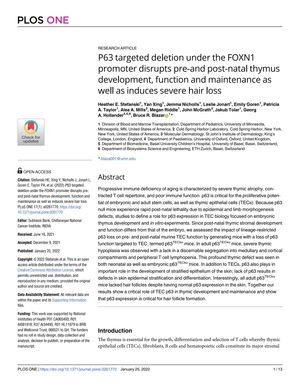
The study investigated the role of the p63 gene in thymic epithelial cells (TECs) and hair follicle formation by creating a mouse model (p63TECko mice) with targeted deletion of p63 in TECs. The findings revealed that adult p63TECko mice exhibited severe thymic hypoplasia, with a lack of segregation into medullary and cortical compartments, and peripheral T cell lymphopenia, indicating a critical role for p63 in both neonatal and embryonic thymic development and function. Additionally, despite normal p63 expression in the skin, all adult p63TECko mice lacked hair follicles, underscoring the importance of p63 in hair follicle formation. This study highlights the essential function of p63 in thymus development, maintenance, and hair growth.

17 citations
,
June 2019 in “The journal of immunology/The Journal of immunology” A specific DNA region is crucial for Foxn1 gene expression in thymus cells but not in hair follicles.
33 citations
,
September 2017 in “Journal of clinical immunology” New treatments for immune disorders caused by FOXN1 deficiency are promising.
33 citations
,
February 2012 in “British Journal of Dermatology” Mutations in the p63 gene affect skin adhesion, barrier integrity, and hair growth.
218 citations
,
April 2008 in “Genes & Development” Skin stem cells help repair damage and maintain healthy skin.
27 citations
,
August 2014 in “Wiley interdisciplinary reviews. Developmental biology” The skin and thymus develop similarly to protect and support immunity.
69 citations
,
January 2013 in “Frontiers in Immunology” The FOXN1 gene is crucial for developing immune cells and preventing immune disorders.
56 citations
,
February 2010 in “PLOS ONE” Blocking Wnt signaling in young mice causes thymus shrinkage and cell loss, but recovery is possible when the block is removed.
54 citations
,
October 2023 in “Oncogene” p63 is essential for controlling epithelial stem cells and tissue health.
86 citations
,
December 2001 in “Experimental dermatology” Mutant mice help researchers understand hair growth and related genetic factors.