Human Pluripotent Stem Cell-Derived Skin Organoids Enabled Pathophysiological Model of Mycobacterium Tuberculosis Infection
December 2025
in “
Nature Communications
”
TLDR Skin organoids can model tuberculosis infection and help test treatments.
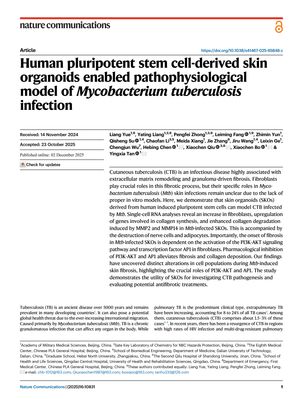
This study demonstrates that skin organoids (SKOs) derived from human induced pluripotent stem cells can effectively model cutaneous tuberculosis (CTB) infected by Mycobacterium tuberculosis (Mtb). The research reveals that Mtb infection in SKOs leads to an increase in fibroblasts, upregulation of collagen synthesis genes, and enhanced collagen degradation, which is linked to the destruction of nerve cells and adipocytes. The onset of fibrosis is driven by the activation of the PI3K-AKT signaling pathway and transcription factor AP1 in fibroblasts. Inhibiting PI3K-AKT and AP1 pharmacologically reduces fibrosis and collagen deposition. These findings highlight the potential of SKOs in studying CTB pathogenesis and testing antifibrotic treatments.