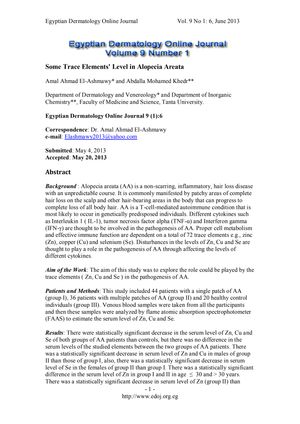
TLDR Alopecia areata patients have lower zinc, copper, and selenium levels than healthy people.
This study investigated the role of trace elements zinc (Zn), copper (Cu), and selenium (Se) in the pathogenesis of alopecia areata (AA) by analyzing serum levels in 44 patients with a single patch of AA, 36 with multiple patches, and 20 healthy controls. Results showed a significant decrease in Zn, Cu, and Se levels in AA patients compared to controls, with no difference between single and multiple patch groups. Notably, males with multiple patches had lower Zn and Cu levels, and females with multiple patches had lower Se levels compared to those with a single patch. Additionally, Zn levels varied significantly with age in both AA groups.
4 citations
,
October 2011 in “Medical journal of Tabriz University of Medical Sciences and Health Services” 2 citations
,
January 2011 in “프로그램북(구 초록집)”  48 citations
,
January 2011 in “International journal of trichology”
48 citations
,
January 2011 in “International journal of trichology” Intralesional triamcinolone acetonide is the most effective treatment for localized alopecia areata.
 65 citations
,
January 2009 in “Annals of Dermatology”
65 citations
,
January 2009 in “Annals of Dermatology” Zinc supplements increased zinc levels in some hair loss patients but didn't significantly improve hair growth.
 60 citations
,
October 2005 in “Experimental Dermatology”
60 citations
,
October 2005 in “Experimental Dermatology” Zinc can both inhibit and stimulate mouse hair growth, and might help recover hair after chemotherapy.
39 citations
,
February 2005 in “Anais Brasileiros de Dermatologia” Alopecia areata is an autoimmune disease with genetic roots, and treatments include specific topical therapies.
 89 citations
,
October 1996 in “Dermatologic Clinics”
89 citations
,
October 1996 in “Dermatologic Clinics” Alopecia areata is likely caused by a combination of genetic factors and immune system dysfunction, and may represent different diseases with various causes.
 17 citations
,
July 1994 in “Journal of Dermatological Science”
17 citations
,
July 1994 in “Journal of Dermatological Science” The cause of alopecia areata is likely a mix of genetics, immune system issues, and environmental factors, with more research needed to understand it fully.
51 citations
,
March 1986 in “Acta Dermato Venereologica” Alopecia patients had similar element levels to normal people, except for differences in copper and low selenium.