Trichoscopy-Assisted Hair Pull Test: A Helpful Adjunct to Trichoscopy for Diagnosing and Managing Alopecias

    Aikaterini Tsiogka, Martin Laimer, Verena Ahlgrimm‐Siess
    Image of study
    TLDR The trichoscopy-assisted hair pull test is useful for diagnosing different types of hair loss.
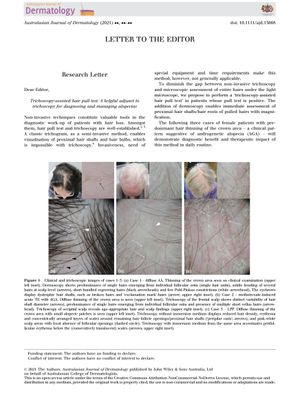
    The document discusses the "trichoscopy-assisted hair pull test," a non-invasive diagnostic method proposed as an adjunct to trichoscopy for evaluating patients with hair loss. The method involves performing a hair pull test and then using dermoscopy to examine the proximal hair shafts and roots of the pulled hairs. Three case studies are presented to illustrate the diagnostic and therapeutic benefits of this method. In the first case, a 22-year-old female with rapid-onset hair shedding was initially suspected of having telogen effluvium (TE), but the trichoscopy-assisted hair pull test revealed features of alopecia areata (AA), leading to a correct diagnosis and effective treatment. The second case involved a 78-year-old female with methotrexate-induced acute TE superimposed on androgenetic alopecia (AGA), and the third case was a 65-year-old female diagnosed with lichen planopilaris (LPP) through the identification of anagen roots. The authors conclude that the trichoscopy-assisted hair pull test is a useful tool for diagnosing various types of hair loss, particularly when the classic hair pull test is positive.

    Discuss this study in the Community →

    Research cited in this study

    6 / 6 results

    Related Community Posts Join

    6 / 78 results

      community 13 days on Ru58841 hair trichoscopy

      in Update  17 upvotes 9 months ago
      The user noticed potential hair growth after 13 days of using RU58841, alongside a regimen of oral minoxidil, finasteride, and topical minoxidil. Others think it's too soon to see results, and some are surprised by the high dosage of oral minoxidil.

      community Predicting Your Hair Loss with a Trichoscopy Report

      in Treatment  7 upvotes 1 year ago
      The conversation discusses the use of trichoscopy to predict hair loss patterns and inform treatment approaches. Treatments mentioned include minoxidil, finasteride, and dutasteride, with varying effectiveness based on gender-specific hair loss patterns.

      community 21m, 2.5 months on 1mg dut & 2.5mg min

      in Progress Pictures  10 upvotes 3 months ago
      A 21-year-old male has been using dutasteride, minoxidil, ketoconazole shampoo, and microneedling for hair loss, with plans to increase minoxidil dosage. He is experiencing no side effects and is planning a trichoscopy to assess hair regrowth.

      community Doctor told me not to take fin.

      in Transplants  17 upvotes 6 days ago
      A doctor advised against taking finasteride after a hair transplant, suggesting the patient had reached their final balding pattern, but many users disagreed, recommending medications like minoxidil and finasteride to prevent further hair loss. The consensus was to seek a second opinion, as the advice seemed financially motivated rather than medically sound.
      21M, Starting to thin. Family history of early balding. Need advice

      community 21M, Starting to thin. Family history of early balding. Need advice

      in General  59 upvotes 4 days ago
      A 21-year-old with a family history of early balding is advised to see a dermatologist to confirm androgenetic alopecia (AGA) and consider treatments like finasteride or dutasteride to prevent further hair loss, and minoxidil, possibly with tretinoin, to regrow hair. Caution is advised with oral minoxidil, and a cardiologist should be consulted before use.

    Related Research

    5 / 5 results