WISP-1 Induced by Mechanical Stress Contributes to Fibrosis and Hypertrophy of the Ligamentum Flavum Through Hedgehog-Gli1 Signaling

    Chao Sun, Qinghong Ma, Jian Yin, Han Zhang, Xinhui Liu
    Image of study
    TLDR Targeting Hedgehog signaling may help treat ligamentum flavum fibrosis.
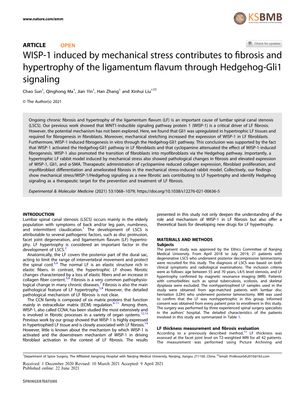
    The study investigated the role of WISP-1 in the fibrosis and hypertrophy of the ligamentum flavum (LF), which contributes to lumbar spinal canal stenosis. It was found that mechanical stress increased WISP-1 expression in LF fibroblasts, which in turn induced fibrogenesis through the Hedgehog-Gli1 signaling pathway. This process was confirmed in vitro and in a hypertrophic LF rabbit model. The study demonstrated that cyclopamine, a Hedgehog pathway inhibitor, reduced fibrosis-related changes, suggesting that targeting Hedgehog signaling could be a potential therapeutic approach for LF fibrosis.

    Discuss this study in the Community →

    Research cited in this study

    1 / 1 results

    Related Community Posts Join

    2 / 2 results

      community Pelage are starting phase 3 for PP405 towards the end of 2026

      in Chat  123 upvotes 1 day ago
      PP405 is moving to late-stage trials, showing potential for hair regrowth, with 31% of male patients experiencing a 20% increase in hair density. Veradermics is developing an oral minoxidil version, and there is interest in combining treatments for better results.

      community Diffuse thinning hair texture changes

      in Chat  1 upvotes 1 year ago
      A user experiencing diffuse thinning since age 18 describes their hair as unhealthy, dry, thin, and hard, with texture changes cycling between good and bad every few weeks. They are not on any medication, only taking vitamins and supplements.

    Similar Research

    5 / 54 results