TLDR The Wnt/β-catenin pathway can activate melanocyte stem cells and may help regenerate hair follicles.
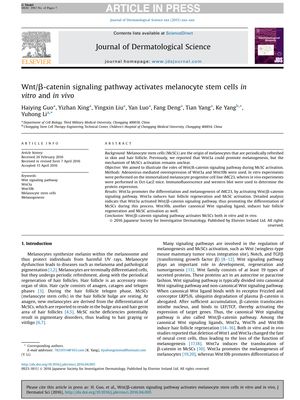
The study from 2016 explored how the Wnt/β-catenin signaling pathway affects melanocyte stem cells (McSCs). In vitro, using the iMC23 cell line, it was found that overexpression of Wnt3a and Wnt10b led to differentiation and melanogenesis by activating this pathway. In vivo experiments with Dct-LacZ transgenic mice showed that these Wnt proteins could induce hair follicle regeneration and activate McSCs. The most effective ligand for inducing melanocyte progenitor differentiation was Wnt3a, followed by Wnt10b and Wnt1. The in vivo results included that intradermal injection of AdWnt3a led to hair follicle regeneration in 67% of the mice (2 out of 3), with the new hair being black, indicating active melanogenesis. These findings highlight the potential of the Wnt/β-catenin signaling pathway in hair follicle regeneration and treatments for pigmentary disorders, although the exact number of samples used was not specified in the summary.

66 citations
,
July 2015 in “Journal of Molecular Biology” The document concludes that for hair and feather growth, it's better to target the environment around stem cells than the cells themselves.
176 citations
,
January 2013 in “Proceedings of the National Academy of Sciences” BMP and Wnt signaling balance controls hair follicle stem cell activity and hair growth.
29 citations
,
January 2013 in “International Journal of Medical Sciences” Wnt10b helps hair follicle cells mature and produce pigment.
300 citations
,
August 2012 in “Seminars in Cell & Developmental Biology” The conclusion is that certain cell interactions and signals are crucial for hair growth and regeneration.
77 citations
,
July 2012 in “Journal of Investigative Dermatology” Wnt10b overexpression can regenerate hair follicles, possibly helping treat hair loss and alopecia.
260 citations
,
June 2011 in “Cell” Wnt signaling is crucial for pigmented hair regeneration by controlling stem cell activation and differentiation.
240 citations
,
April 2011 in “Pigment Cell & Melanoma Research” Melanocyte stem cells in hair follicles are key for hair color and could help treat greying and pigment disorders.
283 citations
,
February 2011 in “Cell stem cell” COL17A1 is crucial for preventing hair graying and loss by supporting hair and pigment stem cells.
10 citations
,
November 2010 in “Pigment Cell & Melanoma Research” Only skin melanocytes, not other types, can color hair in mice.