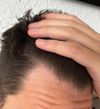
A 23-year-old male is experiencing diffuse hair loss and miniaturization, possibly due to high IGE levels after using tofacitinib. He seeks advice and has not yet consulted a dermatologist.
The conversation discusses using isotretinoin (Accutane) to reduce scalp oiliness and manage scalp issues like seborrheic dermatitis, inflammation, and chronic itch. A user shares that taking 20mg of Accutane every other day effectively reduces oily hair and skin.
The user diagnosed with DUPA tried treatments like dutasteride, finasteride, RU58841, and minoxidil without success and is considering a hair system. They hope for a future cure, possibly with PP405, and others suggest options like scalp biopsy and SMP.
A user's experience with Pyrilutamide, which they have been taking for 3 months to treat their aggressive male pattern baldness. The user reported that the medication decreased shedding and was hopeful it would work as advertised.
The potential hair regrowth benefits of ASC-J9, a synthetic modified version of curcumin that is said to be more effective than Minoxidil and Finasteride. Reports from users suggest good thickening and temple regrowth with topical use at 0.025% concentration.
A 16-year-old researching and trying Pyrilutamide for hair loss treatment, reporting back on side effects experienced after one week of use; the reported side effects included testicle pain, headache, and increased shedding. Libido and sexual performance seemed unaffected.
User starts Nuclear Stack treatment for hair loss, including Dutasteride, Minoxidil, RU58841, Derminator 2, and supplements. Seeks advice on storing and dosing RU58841.
Avoid burning or scarring the scalp for hair growth; instead, use treatments like finasteride, minoxidil, or consider a hair transplant. Microneedling should be done carefully, and extreme methods can cause harm.
The user is using a hair loss treatment regimen that includes RU58841, minoxidil mixed with finasteride, adenosine, dermarolling with lidocaine cream, and biotin. They are questioning if they are dermarolling too aggressively and are willing to accept baldness if no improvement is seen in 6 months.
The conversation discusses the effects of Pyrilutamide on hair growth after two months, with one person noting that while new hair regrowth isn't apparent, existing hair appears longer and thicker.
A young male in his twenties discusses hair loss, mentioning the use of Minoxidil, topical finasteride, and occasional derma rolling. He inquires about scalp inflammation, fibrosis, and the potential benefits of magnesium oil and scalp massages for improving blood flow and hair health.
The user has scheduled a hair transplant after stabilizing hair loss with finasteride and minoxidil, considering additional dermarolling. They are advised to use 2500-3000 grafts conservatively for temple filling without lowering the hairline too much.
The user experienced increased hair loss and scalp itchiness despite using finasteride and plans to resume minoxidil and start microneedling. They are considering using clay, Aveda thickening tonic, and a beanie to manage the appearance of thinning hair.
The conversation discusses potential new treatments for androgenetic alopecia (AGA), including verteporfin, pyrilutamide, and hair cloning. There is optimism about scientific advancements providing alternatives to minoxidil and finasteride.
The user noticed increased hair loss over the past three years and is seeking advice. A suggestion was made to consult a dermatologist or trichologist and consider blood tests, particularly for vitamin D levels, to address potential androgenetic alopecia (AGA).
The conversation discusses the less impressive results of Pyrilutamide (kx-836) in phase 3 compared to phase 2, with a suggestion that a longer study might show more significant results. One user reports personal success with Pyrilutamide, experiencing no further hair loss and gradual regrowth.
Hair loss discussion with a focus on a single resilient hair, jokingly called "chad hair," that remains despite hairline receding. Some users suggest microneedling and hair follicle cloning as potential treatments.
High frequency ultrasonography and HR-MRI can help identify hair shedding causes like inflammation and fibrosis. The conversation discusses the potential of using these technologies to evaluate treatments like Verteporfin for hair regeneration.
The conversation is about considering pyrilutamide 1% as an alternative treatment for hair loss due to intolerance to 5-alpha reductase inhibitors. Some users suggest it might be effective, while others view it as a temporary solution.
The conversation is about using pyrilutamide and RU58841 as topical solutions to prevent hair loss. Pyrilutamide is considered safer but less potent than RU58841, which some users find effective despite potential side effects like heart palpitations.
GHK-Cu injections led to unexpected temple hair growth for someone who had been using minoxidil and finasteride for over a decade. The user plans to continue using GHK-Cu and experiment with a DIY AHK-Cu serum.
The conversation discusses using 2% Pyrilutamide from Anagenica for hair loss, as the user did not see results with 1% Pyrilutamide. The user is considering increasing the dosage but is concerned about the cost.
Pelage Pharmaceutical raised $120 million to continue research on PP405, a promising hair loss treatment that showed a 20% increase in hair density in 31% of men during a Phase 2a trial. The treatment was well-tolerated, with no systemic absorption, and Phase 3 trials are planned for 2026.
The conversation discusses the availability of Breezula, a drug for hair loss, now being sold as an acne treatment, and whether it can be applied to the scalp. Users express skepticism about new hair loss treatments and suggest waiting for FDA approval.
Microneedling depth should be customized based on hair type and scalp area, with many users finding 0.5-0.6mm effective for miniaturized hairs to avoid damage. Users report varying pain levels and results, with some preferring shorter needle lengths and others using longer ones like 1.75mm for scalp health and density improvement.
A discount code for 20% off at Anageninc is shared, valid for purchasing RU58841 or Pyri from May 10-11, 2025. The conversation focuses on hair loss treatments using RU58841.
A user is considering starting spironolactone for androgenetic alopecia but is concerned about stopping it before pregnancy. Another user suggests trying topical treatments as an alternative.
Despite using dutasteride, RU58841, minoxidil, and ketoconazole for years, the user continues to experience severe hair loss and thinning. They seek advice after multiple dermatologists confirmed androgenetic alopecia (AGA) but offered no effective solutions.