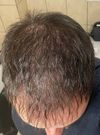
A user ordered a topical dutasteride gel with tretinoin for hair loss after unsatisfactory results with minoxidil and finasteride. Another user shared their experience with the same product, noting its pleasant smell and feel but difficulty in application and uncertainty about its absorption and frequency of use.
The user discusses using Minoxidil and Finasteride for hair loss and plans to counteract potential facial aging from Minoxidil with tretinoin, a jade roller, dandelion root extract, and careful water and sodium intake. They also consider switching to topical Minoxidil and using supplements to enhance treatment response.
User discusses using finasteride, ketoconazole, fish oil, nettle root, saw palmetto, emu oil, and plans to start minoxidil for hair loss. They report maintaining hair with minor side effects like slightly lower libido and watery semen.
A peptide-based delivery system for finasteride shows promise in reducing systemic side effects while maintaining hair growth effectiveness. Combining this with other treatments like minoxidil and RU58841 could enhance results with lower systemic absorption.
A user experienced increased hair density loss after 4 months on dutasteride combined with finasteride. They are also using topical dutasteride with azelaic acid and alfatradiol but cannot tolerate antiandrogens like RU58841 due to headaches.
The conversation discusses using Tretinoin for treating androgenic alopecia. Specific treatments mentioned include Minoxidil, Finasteride, and RU58841.
A 7-month progress report of using finasteride and minoxidil, as well as keto dieting and derma stamping; the discussion also touched on RU58841 and its potential side effects.
KX-826 (Pyrilutamide) 0.5% and 1.0% solutions showed promising results in increasing hair count for male androgenetic alopecia, with the 0.5% dose slightly outperforming the 1% dose. The treatment was well-tolerated with no sexual side effects, but skepticism remains due to past inconsistencies in trial results.
Choosing between two hair loss treatments, with a preference for a higher concentration of RU58841 and 5% minoxidil, avoiding oils like castor and argan that may hinder absorption.
The conversation discusses the effectiveness of reducing DHT for hair loss treatment and explores alternative approaches like reducing androgen receptor sensitivity. Specific treatments mentioned include finasteride, dutasteride, pyrilutamide (KX-826), GT20029, and RU58841.
The conversation discusses the less impressive results of Pyrilutamide (kx-836) in phase 3 compared to phase 2, with a suggestion that a longer study might show more significant results. One user reports personal success with Pyrilutamide, experiencing no further hair loss and gradual regrowth.
RU58841 is discussed for hair loss treatment, with mixed reviews on its effectiveness and side effects. Users mention using it in an ethanol/PG solution and combining it with other treatments like dutasteride.
Minoxidil is more effective when combined with retinoic acid, such as tretinoin or tazarotene, enhancing hair growth. Some users experience significant regrowth, while others see minimal effects or side effects.
Morr F Aqua, an alcohol-free Minoxidil, is discussed for its absorption effectiveness. Users also mention using finasteride and RU58841 for hair loss treatment.
Ell-Cranell and Eucapil are discussed as hair loss treatments, with Ell-Cranell being a weak estrogen and DHT inhibitor that may reduce hair loss without systemic side effects. Alfatradiol is the active ingredient in these products.
A user is documenting their natural approach to treating a receding hairline using a dermastamp, essential oils (rosemary oil at 3% dilution with pumpkin seed oil), a multivitamin with vitamin D, and daily collagen shakes. They acknowledge the common recommendations of minoxidil and finasteride but prefer to test natural methods and share their results.
Hair loss discussion includes finasteride intolerance and questioning if Pyrilutamide is an alternative. Pyrilutamide not commercially available, but may be tolerable if approved since it's not a 5aR inhibitor.
The user mixed RU58841 with Minoxidil for hair loss treatment and experienced reduced hair fall and thicker hair but stopped due to chest pain and muscle twitching. They plan to use a new routine without RU58841 or Finasteride due to side effects, including various topical treatments and peptides.
A user shared their hair regrowth progress using Dutasteride, topical Minoxidil, Spironolactone, and Estradiol Valerate injections as part of hormone replacement therapy for transitioning. They experienced significant hair improvement and personal satisfaction but caution against this approach for non-transitioning individuals due to irreversible changes.
The conversation discusses skepticism about the effectiveness and formulation of a $10 RU58841 gel from a Korean brand, questioning if ethanol is used to hold the active compounds. Concerns are raised about the feasibility of selling it at such a low price.
The conversation is about the potential cost of GT20029 if FDA approved, with estimates around $150/month. Comparisons are made between GT20029, finasteride, and their mechanisms and side effects.
User quit minoxidil and finasteride, starting stemoxydine, dermastamp, and dermapen for hair loss. Seeks advice on alternatives, avoiding androgen disruptors and vasodilators/vasoconstrictors.
The user started a new hair loss treatment regimen using topical finasteride and minoxidil, saw palmetto, sulforaphane, and apple extract supplements, while also trying to quit nicotine and fast food. They later cut out supplements due to cost, continued with topical treatment, and experienced improved hair health but faced issues with low libido.
The user experienced severe scalp itching and hair loss while on dutasteride, which they linked to caffeine and masturbation. They plan to cut out both to see if their hair density improves.
A woman with AGA and CTE has been taking multiple hair loss treatments including spironolactone, dutasteride, finasteride, bicalutamide, birth control, and minoxidil without success. Steroid injections, however, dramatically and immediately stopped her hair loss, though the effect lasts less than a month.
The user experienced a slight decrease in hair shedding and scalp itch, and reduced sebum production using Pyrilutamide, but stopped due to chest pain, breathing difficulties, and heart issues. They felt normal a week after discontinuing and doubted FDA approval for the drug.
The user is experiencing hair loss and plans to use a treatment protocol including Saw Palmetto Berries, MCT Oil, Zinc, testosterone balancers, L-tyrosine, and L-theanine. They also use a specific dandruff shampoo and are open to non-prescription treatments.
RU58841 may pose cancer risks due to its antiandrogen properties and lack of long-term safety data. Using it is considered a high-risk experiment with unknown potential for harm.