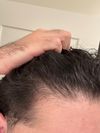
A 21-year-old male with a thyroid condition noticed his hair thinning uniformly without a receding hairline. He is considering using a 5ARI to prevent further baldness if he starts TRT.
How androgens, including testosterone, can cause hair follicles to miniaturize in people with sensitivity to androgens, and treatments such as finasteride, dutasteride, minoxidil, RU58841, or fluridil may be used in combination for long-term treatment.
A 27-year-old male with diffuse hair loss, including the donor area, did not respond to finasteride, dutasteride, or minoxidil. He suspects his hair loss may be linked to a mild connective tissue disorder, possibly affecting the structural support of hair follicles, rather than being purely hormonal.
A man in his 40s treating his slow balding with a daily regimen of 2.5% spironolactone topical solution and Piroctone Olamine Shampoo. Despite initial hair shedding, he experienced no side effects and plans to continue the treatment for at least a year.
A user's hair regrowth journey using biotin and minoxidil after initial treatments with Nizoral shampoo and Ketoconazole serum didn't work. The comments suggest the hair loss might not be male pattern baldness (MPB), but possibly Alopecia Areata, an autoimmune disorder, and recommend getting a second opinion and considering other treatments like corticosteroids.
L. reuteri, a probiotic, is being explored for its potential benefits in treating androgenic alopecia, possibly enhancing finasteride's effects and reducing inflammation. The user combines this with finasteride, oral minoxidil, and other supplements, noting some improvement in hair loss.
Hair loss may be caused by calcification of capillaries in the scalp, restricting blood flow to hair follicles. A daily treatment regimen including high doses of Vitamins D and K, Magnesium, and Nattokinase could potentially decalcify these capillaries, improving blood flow and hair growth. However, some users warn against excessive Vitamin D intake and emphasize the need for medical consultation.
The user experienced hair thinning from chromium and alpha lipoic acid supplements, which stopped after discontinuing them. Someone mentioned this could be telogen effluvium, a temporary condition.
The user noticed increased hair loss over the past three years and is seeking advice. A suggestion was made to consult a dermatologist or trichologist and consider blood tests, particularly for vitamin D levels, to address potential androgenetic alopecia (AGA).
A 20-year-old with diffused thinning is using oral minoxidil for androgenetic alopecia. They plan to switch to topical minoxidil, finasteride, and bimatoprost, and may consider surgery if their condition improves.
A user experiencing diffuse thinning since age 18 describes their hair as unhealthy, dry, thin, and hard, with texture changes cycling between good and bad every few weeks. They are not on any medication, only taking vitamins and supplements.
Treatments for hair loss, such as topical minoxidil, platelet-rich plasma therapy with or without minoxidil, ketoconazole, non-abative radio frequency, natural products, finasteride and cortexolone 17 alpha propionate. The post evaluates the efficacy and safety of these treatments in various studies.
User on Dut, oral minox 20 mg, Saw Palmetto, Pumpkin Oil, RU, 8% topical minox, and topical fina for hair loss; top of head improves, but retrograde alopecia worsens. Asks for options besides exosomes and where to find topical melatonin.
Balding scalps have more androgen receptors, leading to increased TGF-beta, which causes blood vessel loss and hair follicle miniaturization. Blocking androgen signaling and TGF-beta may help prevent hair loss.
Obscure hair loss topicals like Alfatradiol, Fluridil, and Stemoxydine are discussed. They may be considered for those not responding well to common treatments like Minoxidil and Finasteride.
New hair loss treatments PP405 and VDPHL01 are discussed with skepticism and hope, alongside existing treatments like minoxidil and finasteride. Users express frustration over limited progress since the 1980s but remain cautiously optimistic.
A user with diffuse thinning noticed stubble-like hairs on their scalp after using 2% ketoconazole shampoo, dermarolling, castor oil, Vitamin D3, biotin, and iron supplements. They are unsure if this indicates regrowth or miniaturized hairs.
Clascoterone 5% solution (Breezula) is a promising alternative for androgenetic alopecia, showing continued hair growth with consistent use and no significant side effects. It may be suitable for those who cannot tolerate finasteride or dutasteride, especially when trying to conceive.
A user started using topical finasteride 0.1% with Aloe Vera 0.05% on May 19, 2023, to address hair loss that began at age 27. They plan to post progress pictures every three months.
Clascoterone in Winlevi, a topical AR antagonist, is being re-examined due to concerns about HPA axis suppression in adolescents, but it's unlikely to be banned for adult use in androgenetic alopecia (AGA). The European Medicines Agency recommended refusing Winlevi for acne vulgaris, but this may not affect Breezula's approval for AGA.
Exosomes combined with fractional picosecond laser treatment were effective in treating androgenetic alopecia and promoting repigmentation in white hair patches. The role of exosomes in hair repigmentation, particularly in conditions like poliosis, is not well-studied.
Tae147 has shared results of using pyrilutamide, a 5% concentration topical solution applied twice daily, in combination with minoxidil, to reduce scalp itchiness and hair shedding. Other users have shared their experiences with the treatment, as well as questions about its availability on the market.
A person is treating their hair loss with oral minoxidil (2.5mg), derma stamping, and dutasteride (0.5mg) for nearly a year but still feels their hair isn't dense enough to grow out. Commenters are generally supportive, noting progress and suggesting it may look denser than the person perceives.
A female with PCOS and androgenetic alopecia is starting treatment with oral Minoxidil, topical Minoxidil 5% with finasteride, and plans to add mesotherapy. She previously tried anti-androgenic contraceptive pills but couldn't tolerate them and is using Myo Inositol for weight management.
A 28 year old using a hair loss prevention protocol to restore thinning hair, which includes finasteride, dutasteride, minoxidil, stemoxydine, alopecin, nizoral shampoo and microneedling; the user is now adding pyrilutamide solution to the regimen with the hope of improving their results. RU58841 was also ordered but not yet used.
The user is treating androgenetic alopecia with finasteride and discovered a folic acid deficiency. They are asking if curing the deficiency can worsen or improve their hair condition.
The user is considering using dutasteride or finasteride for hair loss and has recurrent folliculitis. Another user suggests treating the folliculitis and notes diffuse thinning.
The user is experiencing one-sided diffuse thinning and has been using finasteride and liquid minoxidil for 4-5 years with minimal results. They are considering whether to save for a hair transplant or address scalp sensitivity and irritation first.