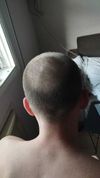
User seeks advice for regrowing temples, currently using Fin, oral Min, and dermarolling. Suggestions include improving scalp environment and considering RU58841 or dutasteride.
The user has been using finasteride (2mg daily) to halt hair loss and is considering dermarolling with essential oils (Rosemary, Thyme, Peppermint, Tea Tree, Lavender, Jojoba) to restore the hairline. They are hesitant to use Minoxidil due to concerns about losing gains if they stop.
Sulfur soap may help with hair thickening and reducing scalp inflammation, but it can cause dryness. Nizoral, containing ketoconazole, is noted for its potential to reduce seborrheic dermatitis but may also cause scalp dryness and hair loss.
User started minoxidil, noticed forehead lines and dark circles, and asked for non-invasive skin aging prevention methods. Another user suggested using tretinoin and hyaluronic acid for long-term benefits.
The user is considering adding a scalp massager to their current hair loss treatments, which include finasteride, minoxidil, pumpkin seed oil, and microneedling. They are seeking advice on whether to invest in a scalp massager or remain patient with their current regimen.
The conversation discusses alternative and unorthodox hair loss treatments, including RU58841, nandrolone, and dianabol, as well as theoretical approaches involving high doses of estrogen and selective estrogen receptor modulators. These methods are considered extreme and potentially harmful but are explored for those unable to tolerate traditional 5-alpha reductase inhibitors.
The user is concerned about hair loss despite taking finasteride and has a hair transplant scheduled. They experience scalp itching and burning, which hasn't been relieved by various treatments, and another user suggests using ghk-cu & ahk-cu serum and Koshine kx-826/pyrilutamide for relief.
The conversation discusses hair loss treatments, specifically Setipiprant, finasteride, and bimatoprost. Setipiprant is suggested for maintenance, while bimatoprost is for regrowth, and combining them with dermarolling is recommended for better results.
The conversation is about using bicalutamide, taken less frequently than daily, for hair loss treatment. The user is considering 50mg every 3 days or once a week and is asking for others' experiences.
The user is taking finasteride for hair loss and is considering adding Resveratrol and Bio-Quercetin supplements for general wellbeing. They are concerned about potential interactions affecting the effectiveness of finasteride.
The user discusses switching from multiple vitamins to a single multivitamin pill. They also mention using oral finasteride and topical minoxidil with finasteride for hair loss treatment.
Natural vitamins like pumpkin seed oil, saw palmetto, and ecklonia cava are discussed for their potential to lower DHT levels. They may work similarly to finasteride but are significantly weaker.
Finasteride is essential for hair loss prevention, while minoxidil is optional. Additional treatments include a natural shampoo, a healthy diet, scalp massages, microneedling, laser therapy, and supplements like fish oils and biotin.
A user is considering hair loss treatments like caffeine shampoo, rosemary oil, pumpkin seed supplements, and microneedling, but is unsure if these are effective compared to finasteride. Another user suggests trying finasteride or dutasteride, sharing regret for not starting earlier.
Pyrilutamide's effect on sebum production and scalp inflammation is unclear, with users noting no significant changes. Isotretinoin is mentioned as effective for reducing sebum, while Dutasteride and various shampoos have limited impact on oiliness and seborrheic dermatitis.
The conversation is about using Peppermint or Spearmint oil for hair loss and asks for successful regimens, including brands, carrier oils, and application details. No specific treatments were shared.
The user stopped using Alfatradiol after 4 months due to no hair improvement and side effects like dry scalp and gallbladder pain. They are considering trying topilutamide, which is suggested as an alternative.
Rice water was used as a hair treatment and showed noticeable results in a week, more than finasteride used for seven months. The user plans to continue using rice water and might stop finasteride, while still using ketoconazole for dandruff.
The user's hair regrowth plan includes topical treatments (RU58841, azelaic acid, ketoconazole), oral supplements (Gia Herbs, castor oil), microneedling, PTD-DBM peptide with valproic acid, red light therapy, inversion table with scalp massage, and platelet-rich fibrin injections. Commenters suggest that finasteride and minoxidil are essential treatments for male pattern hair loss, which are missing from the plan.
The conversation discusses a 4-month hair regrowth protocol that includes finasteride (1.25mg), RU58841, dermarolling, ketoconazole, minoxidil, peppermint oil, and fatty acids/oils. Progress pictures are shared to show the results of these treatments.
The conversation emphasizes the importance of starting hair loss treatment early, using options like minoxidil, finasteride, RU58841, essential oils, and dermarolling, and encourages leaving the hair loss subreddit once treatment begins to avoid stress and obsession. Users shared personal success with finasteride and the motivation to start treatment to prevent future regret.
A topical treatment called 1961, containing multiple products, is discussed for its compatibility with finasteride. It is suggested that 1961 does not negatively affect finasteride's effectiveness and may even enhance its absorption.
The individual is considering starting hair loss treatment with dutasteride, prescribed by a dermatologist, due to concerns about finasteride side effects. They are also interested in the potential benefits of reducing DHT and are contemplating whether to maintain a shaved head or pursue treatment.
The user stopped using finasteride and RU58841 and is considering CB-03-01 for androgenic alopecia but is concerned about the cost and effectiveness, especially at a lower dose than in clinical trials. They are also using minoxidil, micro-needling, and nizoral shampoo but are unsure about the correct application method for CB-03-01.
The user is experiencing scalp irritation from a compounded treatment of finasteride, minoxidil, and tretinoin. They are considering switching to a non-alcohol, propylene glycol-free formula with a lower tretinoin percentage to reduce irritation.
The user is using finasteride 1mg every other day and seeks a topical solution to complement it, excluding minoxidil. They are considering various combinations of ingredients like finasteride, dutasteride, and tofacitinib, with options for nourishing oils and other additives.
A 51-year-old on TRT plans to use steroids and is concerned about hair loss, considering topical treatments like Hair Rescue with RU58841 and finasteride, along with Nioxin shampoo. They are cautious about using oral DHT blockers due to potential interactions with steroids like Tren and Anavar.
OP had a doctor appointment, was advised to try B vitamins and change shampoo for hair loss, and may consider Finasteride if no improvement. Users suggest seeing a dermatologist directly, as vitamins likely won't help much with AGA.
Hair cloning and new treatments like ET-02, Veradermics (vdphl01), and wound-induced hair neogenesis show promise but are not yet widely available. Current effective treatments include minoxidil, finasteride, and dutasteride, with early intervention being crucial for better outcomes.