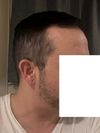
A user's nine-month journey of hair growth with treatments including finasteride, minoxidil, and nizoral; some participants thought the user had a hair transplant while others disagreed.
A user shared progress pictures after 8 months of using topical 5% minoxidil and 0.01% finasteride, showing significant hair regrowth. Replies suggest the user might not need a hair transplant and recommend considering oral finasteride.
An 18-year-old male using minoxidil and finasteride is experiencing increased hair loss, possibly due to a shedding phase from finasteride. He also takes zinc, magnesium, calcium, and vitamin C, and is concerned about hair loss from his temples.
The conversation discusses whether a longtime NW7 scalp has vellus hairs under a microscope or is completely smooth. Treatments mentioned include Minoxidil, finasteride, and RU58841.
User considers trying AAPE for hair restoration, costing $700 for 6 months. Others discuss its potential effectiveness and mention a study with promising results.
Scientists discovered a new T cell treatment that could regrow hair. Users are skeptical but hopeful, with some relying on finasteride and minoxidil in the meantime.
User shows temple area progress after hair transplant, using DUT every other day and oral Min 2.5 daily. Another user asks about number of grafts and cost.
The conversation is about a person's 6-week progress using 2.5 mg oral minoxidil, 0.5 mg dutasteride, weekly derma stamping at 1.5 mm, and rosemary oil for hair loss, with some initial shedding but no side effects. They are optimistic about future results.
The user has been using minoxidil and finasteride for 7.5 months to address hair thinning, particularly at the crown and temples, and is considering additional treatments like tretinoin and dermastamping despite having chronic scalp folliculitis. They are experiencing progress but are concerned about side effects and the effectiveness of treatments on temple regrowth.
Hair follicles don't truly die but become severely miniaturized. Treatments like finasteride, dutasteride, and minoxidil can help restore hair by providing nutrients and reducing harmful effects on hair roots.
The user has been using minoxidil foam and mesotherapy with dutasteride since February 2024 for hair loss. They are seeking opinions on their progress, considering dermarolling, and asking for shampoo suggestions.
A user is concerned about hair loss in the temple area despite using Minoxidil and finasteride for 10 months and is curious if PP405 can help. Responses indicate uncertainty about PP405's effectiveness, with some optimism about future treatments and AI speeding up drug discovery, but emphasize waiting for clinical trial results.
The conversation is about using dutasteride mesotherapy with a dermaroller for treating a receding hairline, especially on the temples. The user is seeking advice on its effectiveness.
A new topical treatment, PP405, shows promising results for hair regrowth, potentially outperforming existing treatments like finasteride and minoxidil. However, it may still need to be combined with DHT blockers for optimal results, and its long-term effectiveness remains uncertain.
KX-826 (Pyrilutamide) 0.5% and 1.0% solutions showed promising results in increasing hair count for male androgenetic alopecia, with the 0.5% dose slightly outperforming the 1% dose. The treatment was well-tolerated with no sexual side effects, but skepticism remains due to past inconsistencies in trial results.
A compound called MTP3 from the Monoterpene family was found to be safe and highly effective at treating hair loss by inhibiting the FGF5 gene, but its identity is undisclosed for commercial reasons. No specific treatments like Minoxidil, finasteride, or RU58841 were discussed.
The user reports significant hair density improvement after 8.5 months of using finasteride, with no side effects except for initially watery semen. They also mention increased sex drive, which they attribute to finasteride, and regret not starting the treatment earlier due to fear of side effects.
The user's consideration of taking finasteride as a short-term treatment, while awaiting advances in medical technology such as Pyrilutamide and GT20029; other users' experiences with Finasteride, including potential side effects.

Clascoterone is seen as a promising topical treatment for hair loss, similar to finasteride but without side effects, though concerns exist about its long-term effectiveness. Other treatments discussed include topical minoxidil, ketoconazole, microneedling, and oral options like dutasteride and minoxidil.
The conversation humorously discusses inducing goosebumps to potentially reverse hair loss, with mentions of using cold therapy and muscle exercises. It also references other unconventional ideas like removing a testicle to lower DHT.
The user experienced hair regrowth and strengthening using finasteride, minoxidil, micro-needling, Nizoral, and biotin products. Despite progress, they acknowledge that a hair transplant may be needed for full hairline restoration.
The user has been using topical minoxidil and finasteride for six months and is seeing some hair regrowth. Other users suggest not to stop using the products as gains could disappear quickly, and some people respond better to topical treatments than pills.
The conversation is about people with advanced hair loss (Norwood 6 or 7) who have seen significant hair regrowth using treatments like finasteride, minoxidil, microneedling, and RU58841. Nine cases were collected to motivate others to try these treatments despite advanced hair loss.
A user experienced androgenic alopecia starting at the vertex without frontal hairline recession and is seeking information on this pattern. Another user noted that vertex or diffuse hair loss is common among men.
The user is experiencing hair thinning and loss at the temples, likely due to androgenetic alopecia. Suggested treatments include finasteride and minoxidil to slow hair loss and promote regrowth, with buzzing hair short as a styling option.
A user struggles with male pattern baldness and a persistent tingling itch on their crown, trying various treatments like aloe vera, tea tree oil, and Nizoral without success. Another user suggests the itch might be psychosomatic, linked to worrying about hair loss.
A user shared their 2-month progress on finasteride 1mg daily and weekly derma rolling, showing noticeable hair regrowth. Replies confirm visible improvement, though some attribute it partially to lighting.
A woman experienced hair regrowth after using self-prescribed finasteride and dutasteride from online sources, despite doctors' reluctance to prescribe these due to potential birth defects. Her dermatologist acknowledged the effectiveness of these treatments and advised her to continue using them while avoiding pregnancy.
Participants want to maintain hair until at least age 30, using treatments like finasteride, dutasteride, and minoxidil. Hair loss remains a concern, with some considering hair transplants.
The user shared progress pictures showing hair improvement over 7-8 months using topical finasteride 0.1% and minoxidil 0.5%. Others complimented the results and inquired about the source of the treatments.