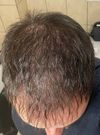
A user discusses a topical treatment combining Minoxidil, Betamethasone Valerate, Canrenone, Finasteride, and Dutasteride for hair loss. The treatment is RX-only and provided by a dermatologist.
The conversation discusses using very low dose topical finasteride to achieve specific serum DHT reduction percentages. It concludes that finasteride dosage increases linearly between 5-30% DHT reduction but requires exponential increases for reductions up to 70%.
Topical finasteride concentrations are likely much higher than necessary for effective follicular DHT suppression, with current standards being 100-1000 times above the theoretical minimum. Lower concentrations (0.001-0.0025%) might still work locally while minimizing systemic exposure.
The conversation is about concerns over using a combination spray containing finasteride, minoxidil, and ketoconazole for hair loss. The user is worried about potential scalp irritation and considers using separate products to better manage sensitivity.
A user with androgenetic alopecia is using 8 ml of 1.4% topical spironolactone solution daily but is unsure if this amount is excessive, as 2 ml is more typical. They seek advice on the appropriate amount to apply.
Vitamin D tests like D2, D3, and 25-hydroxyvitamin D are discussed before starting hair treatment. Vitamin D can be obtained from food, but overdose has side effects.
A male in his early 40s, who experienced side effects from finasteride, used 2.5% topical spironolactone for one year with no side effects but minimal regrowth. He plans to try a 5% spironolactone solution next.
The conversation discusses the importance of scalp skin barrier health in hair follicle cycling, suggesting treatments like ceramides or niacinamide to support hair growth. It also mentions the use of finasteride for hair loss.
The user shared a 6-month update on their hair loss treatment using finasteride, minoxidil, Nizoral shampoo, and vitamin D. They reported progress but mentioned possible sexual side effects and recent shedding, seeking advice on adjusting their finasteride dose.
Latanoprost is discussed as a potential hair loss treatment, noted for its synergy with minoxidil and 5-AR inhibitors, but concerns include its effectiveness on scalp hair, cost, and potential skin darkening. Some users express interest in trying latanoprost or bimatoprost despite limited real-world evidence.
PP405 may damage hair follicles if used long-term, suggesting cycling might be necessary. Combining it with finasteride could help maintain hair growth.
The user switched from oral minoxidil to topical minoxidil and added JXL-069/PP405-3HP, along with topical dutasteride, melatonin, and tretinoin. They also use low-level laser therapy (LLLT) but doubt its effectiveness.
Adding tretinoin can enhance the effectiveness of minoxidil by increasing sulfotransferase levels, making it beneficial for hair growth. However, it may not be necessary if using oral minoxidil.
The conversation is about experimenting with topical exosomes for hair loss treatment, alongside microneedling, Happy Head's gel-like topical, and Ordinary's hair serum. The user also mentions the availability of treatments like latanoprost and Redensyl.
The conversation discusses the potential of creating a homemade sulforaphane topical for hair loss treatment. Participants mention challenges with sulforaphane stability and reference other treatments like Minoxidil.
User shares 9-month progress using topical Fin/Min formula (10% Min, 0.1% Fin) for hair loss, with significant improvement in crown area. Others discuss experiences, side effects, and application methods for the treatment.
Upcoming hair loss treatments for those who can't tolerate DHT blockers, focusing on Minoxidil, microneedling, and ketoconazole. Promising treatments include GT20029, PP405, KX-826, and RU58841, though RU58841 may not be safe.
The conversation discusses sourcing topical dutasteride for hair loss treatment, with mentions of Dr. Mwamba's products and Farmacia Prati as potential suppliers. Additional treatments like topical tocotrienols and botox are suggested as extensions to the regimen.
OP saw significant hair growth after starting scalp exfoliation and using 5% topical minoxidil for 4.5 months, along with microneedling initially. Users discussed the benefits of exfoliation and inquired about experiences with finasteride and dutasteride.
A 23-year-old is considering using a topical solution of Finjuve (finasteride and minoxidil) at a reduced dosage of 0.2/0.4mg to treat crown thinning while minimizing side effects. Applying 0.1-0.2 mL is suggested to lower systemic absorption and effectively reduce DHT on the scalp.
The user is seeking a topical spray combining finasteride, minoxidil, and RU58841 or dutasteride due to side effects from oral treatments. They believe an all-in-one topical solution would be easier for long-term use.
Concerns about the long-term safety of VDPHL01, an extended-release minoxidil, due to potential risks similar to Cantu syndrome, were raised, highlighting the lack of monitoring for chronic connective tissue changes. The conversation suggests that while the treatment may improve hair growth, it could lead to issues not detected in short-term trials.
A user with scalp psoriasis and hair loss is hesitant to use topical minoxidil and finasteride due to concerns about psoriasis and potential side effects. They are considering alternatives like pumpkin seed and saw palmetto.
A product that makes hair look thicker and healthier without promoting regrowth. Discussions include treatments like minoxidil, finasteride, red light therapy, and a serum with caffeine and peptides, with mixed effectiveness opinions.
The user is exploring alternatives to finasteride and dutasteride due to concerns about side effects, and is using rosemary and jojoba oil, ketoconazole, minoxidil, microneedling, multi-peptide serum, saw palmetto, and stinging nettle for hair loss. They are also considering CB 03 01 and spironolactone.
The user has been using a treatment of 0.1% topical finasteride, 5% minoxidil, dermastamping, and vitamin D3 supplements for 85 days and is seeing good progress. Other users note the effectiveness of topical finasteride despite it being less potent.
The user is seeing progress in hair regrowth using a combination of 8% minoxidil, 0.25% dutasteride, and 0.01% tretinoin. The conversation includes comments on the effectiveness and application of these treatments.
A 36-year-old has been using oral finasteride (1 mg daily) and topical minoxidil twice a day since September 2023, and added LLLT (helmet) to their routine 2 months ago, seeing positive changes. They also use Ketoconazole shampoo, rotate other medical shampoos, train regularly, eat clean, and manage stress.