 24 citations
,
May 2019 in “PLOS ONE”
24 citations
,
May 2019 in “PLOS ONE” The African spiny mouse can fully regenerate its muscle without scarring, unlike the common house mouse.
 13 citations
,
January 2020 in “Scientific Reports”
13 citations
,
January 2020 in “Scientific Reports” The African spiny mouse heals skin without scarring due to different protein activity compared to the common house mouse, which heals with scarring.
 40 citations
,
November 2021 in “npj Regenerative Medicine”
40 citations
,
November 2021 in “npj Regenerative Medicine” Adult spiny mice recover better from heart attacks than common lab mice.
 418 citations
,
September 2012 in “Nature”
418 citations
,
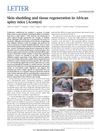
September 2012 in “Nature” African spiny mice can regenerate skin, hair, and cartilage, but not muscle, and their unique abilities could be useful for regenerative medicine.
April 2019 in “The journal of investigative dermatology/Journal of investigative dermatology” Spiny mice regenerate skin better than laboratory mice due to larger hair bulges, more stem cells, and different collagen ratios.
39 citations
,
June 2018 in “Burns” The spiny mouse can fully regenerate skin after burns, unlike the lab mouse.
 June 2022 in “bioRxiv (Cold Spring Harbor Laboratory)”
 A specific molecular switch, driven by MAPK/ERK signaling, helps spiny mice heal wounds by regenerating skin instead of forming scars.

Aging disrupts skin repair and stress responses, but exercise-related IL-15 improves wound healing and skin health in older skin.
 January 2023 in “Biomaterials Science”
 Certain genes are more active during wound healing in axolotl and Acomys, which could help develop materials that improve human wound healing and regeneration.
4 citations
,
January 2025 in “Annals of the New York Academy of Sciences” Spiny mice can regenerate tissues instead of forming scars.
April 2018 in “Journal of Investigative Dermatology” African spiny mice can regenerate skin and hair after wounds due to specific tissue mechanics.
 37 citations
,
February 2019 in “Experimental Dermatology”
37 citations
,
February 2019 in “Experimental Dermatology” Spiny mice are better at regenerating hair after injury than laboratory mice and could help us understand how to improve human skin repair.
5 citations
,
August 2023 in “G3 Genes Genomes Genetics” The improved genome of the African spiny mouse will help understand its tissue regeneration abilities.
4 citations
,
April 2023 in “bioRxiv (Cold Spring Harbor Laboratory)” The improved genome of the African spiny mouse helps study its tissue regeneration.
 1 citations
,
August 2023 in “Genome research”
1 citations
,
August 2023 in “Genome research” The spiny mouse regenerates ear tissue asymmetrically, with gene expression differences possibly explaining its unique healing abilities.
 1 citations
,
April 2023 in “Science Advances”
1 citations
,
April 2023 in “Science Advances” High levels of ERK activity are key for tissue regeneration in spiny mice, and activating ERK can potentially redirect scar-forming healing towards regenerative healing in mammals.
 March 2026 in “bioRxiv (Cold Spring Harbor Laboratory)”
 Spiny mice have a unique skin structure that helps them heal and regenerate quickly.
 24 citations
,
May 2018 in “Journal of Molecular Endocrinology”
24 citations
,
May 2018 in “Journal of Molecular Endocrinology” The spiny mouse is a unique menstruating rodent that can help us understand menstruation and reproductive disorders.
 19 citations
,
November 2018 in “Experimental Dermatology”
19 citations
,
November 2018 in “Experimental Dermatology” The spiny mouse can regenerate its skin without scarring, which could help us learn how to heal human skin better.
February 2025 in “Proceedings of the National Academy of Sciences” Only Deomyinae rodents can regenerate complex tissues.
 22 citations
,
May 2021 in “Nature Communications”
22 citations
,
May 2021 in “Nature Communications” Tissue stiffness affects hair follicle regeneration, and Twist1 is a key regulator.
 1 citations
,
August 2023 in “bioRxiv (Cold Spring Harbor Laboratory)”
1 citations
,
August 2023 in “bioRxiv (Cold Spring Harbor Laboratory)” Certain cells in the adult mouse ear come from cranial neural crest cells, but muscle and hair cells do not.
 1 citations
,
January 2019 in “The International Journal of Lower Extremity Wounds”
1 citations
,
January 2019 in “The International Journal of Lower Extremity Wounds” Artificial dermal template treatment can stimulate complete skin and hair follicle regrowth.
 408 citations
,
January 2017 in “Science”
408 citations
,
January 2017 in “Science” Some wound-healing cells can turn into fat cells around new hair growth in mice.
 359 citations
,
January 2015 in “Cold Spring Harbor Perspectives in Medicine”
359 citations
,
January 2015 in “Cold Spring Harbor Perspectives in Medicine” Hair growth phase and certain genes can speed up wound healing, while an inflammatory mediator can slow down new hair growth after a wound. Understanding these factors can improve tissue regeneration during wound healing.
 301 citations
,
February 2019 in “Nature Communications”
301 citations
,
February 2019 in “Nature Communications” The research found that different types of fibroblasts are involved in wound healing and that some blood cells can turn into fat cells during this process.
 252 citations
,
February 2018 in “npj Regenerative Medicine”
252 citations
,
February 2018 in “npj Regenerative Medicine” Understanding different species' regeneration can improve mammalian healing.
 145 citations
,
November 2018 in “Nature Communications”
145 citations
,
November 2018 in “Nature Communications” The Sonic hedgehog pathway is crucial for new hair growth during mouse skin healing.
 85 citations
,
December 2017 in “Developmental Biology”
85 citations
,
December 2017 in “Developmental Biology” Mammals might fail to regenerate not because they lack the right cells, but because of how cells respond to their surroundings, and changing this environment could enhance regeneration.
 65 citations
,
March 2018 in “Journal of Dermatological Science”
65 citations
,
March 2018 in “Journal of Dermatological Science” Skin problems can be caused or worsened by physical forces and pressure on the skin.