 20 citations
,
May 2015 in “Regenerative Medicine”
20 citations
,
May 2015 in “Regenerative Medicine” The document warns against US clinics selling untested stem cell treatments without FDA approval.
 20 citations
,
January 2014 in “Journal of Cosmetics, Dermatological Sciences and Applications”
20 citations
,
January 2014 in “Journal of Cosmetics, Dermatological Sciences and Applications” Using adipose derived stem cells and growth factors in hair transplants may improve healing and hair growth.

Fat tissue can potentially treat a common form of hair loss called androgenic alopecia.
17 citations
,
March 2016 in “PubMed” Adipose-derived stem cells show promise for hair growth but need improvement for clinical use.
 30 citations
,
June 2017 in “Current stem cell research & therapy”
30 citations
,
June 2017 in “Current stem cell research & therapy” Adipose-derived stem cells (fat cells) show promise in treating hair loss in both men and women.
48 citations
,
March 2020 in “Stem Cell Research & Therapy” Using a collagen sponge scaffold helps stem cells become more like skin cells.
 1 citations
,
February 2022 in “Experimental Dermatology”
1 citations
,
February 2022 in “Experimental Dermatology” Certain proteins are found at higher levels in balding areas compared to non-balding areas, suggesting a link to hair loss. This could be useful for diagnosing and treating hair loss.
 April 2021 in “Journal of Cosmetic Dermatology”
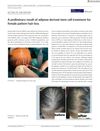
 Stem cell treatment improved hair density in female hair loss patient.
2 citations
,
May 2021 in “International journal of molecular sciences” Stem cells from hair follicles in a special gel show strong potential for bone regeneration.
 6 citations
,
January 2018 in “Journal of Cellular Physiology”
6 citations
,
January 2018 in “Journal of Cellular Physiology” Human scalp fat stem cells showed improved cartilage-like development on a special scaffold with freeze-thaw treatment.
30 citations
,
October 2014 in “Experimental Dermatology” Leptin from skin fat can slow hair growth during certain phases.
2 citations
,
June 2024 in “Frontiers in Immunology” 3D cultures can create active macrophages from fat tissue.
January 2022 in “Springer eBooks” Combining PRP with lipofilling shows promise for tissue regeneration but needs more clinical trials to confirm benefits.

Low-level laser therapy may help stem cells grow and function better, aiding in healing and tissue repair.
 9 citations
,
March 2022 in “Frontiers in Immunology”
9 citations
,
March 2022 in “Frontiers in Immunology” Foxp3+ Regulatory T Cells are important for immunity and tolerance, affect hair growth and wound healing, and their dysfunction can contribute to obesity-related diseases and other health issues.
 3 citations
,
January 2014 in “Elsevier eBooks”
3 citations
,
January 2014 in “Elsevier eBooks” Different stem cells have benefits and challenges for tissue repair, and more research is needed to find the best types for each use.
 2 citations
,
January 2017 in “AIMS cell and tissue engineering”
2 citations
,
January 2017 in “AIMS cell and tissue engineering” Mesenchymal stem cells show promise for treating various skin conditions and may help regenerate hair.
May 2026 in “Ibero-American Journal of Health Science Research” Regenerative therapies like PRP and stem cells are promising for skin rejuvenation and repair.
 September 2023 in “Stem cell reviews and reports”
 Scientists found a new, less invasive way to get stem cells from horse hair for veterinary medicine.
Nanofat injection is safe and effective for improving skin texture and patient satisfaction.
 31 citations
,
December 2014 in “Advances in Clinical and Experimental Medicine”
31 citations
,
December 2014 in “Advances in Clinical and Experimental Medicine” Stem cells could improve plastic surgery but are not widely used due to cost and safety concerns.
 2 citations
,
March 2019 in “Plastic and Reconstructive Surgery”
2 citations
,
March 2019 in “Plastic and Reconstructive Surgery” The letter suggests that a modified fat processing technique may increase regenerative cells but calls for more trials to confirm its effectiveness for skin and hair treatments.
1 citations
,
January 2025 in “Reproductive Biology and Endocrinology” Cell-free fat extract may boost IVF success in older women with past failures.
September 2025 in “Stem Cell Research & Therapy” TAZ boosts fat cell formation in goat stem cells by activating a specific signaling pathway.
 January 2015 in “D-Scholarship@Pitt (University of Pittsburgh)”
 Diabetic patients' stem cells make vascular grafts more prone to clots, but new methods may improve grafts.
July 2017 in “DOAJ (DOAJ: Directory of Open Access Journals)” SVF-enhanced fat injections may effectively treat baldness by promoting hair growth.
Extracellular matrix components affect stem cell growth and adhesion differently based on their source.
12 citations
,
January 2018 in “PubMed” Y-27632 helps hair follicle stem cells grow and keep their abilities.
212 citations
,
January 2017 in “Mediators of Inflammation” Stem cells show promise in speeding up wound healing and tissue regeneration.
 December 2025 in “Scientific Reports”
 Cedrol may help reduce liver fat and fat cell growth caused by corticosteroids.