 11 citations
,
August 2018 in “Facial Plastic Surgery Clinics of North America”
11 citations
,
August 2018 in “Facial Plastic Surgery Clinics of North America” Adipose-derived stem cells show potential for skin rejuvenation and wound healing but require more research to overcome challenges and ensure safety.
7 citations
,
January 2022 in “Biomedicines” Cells from the lower part of hair follicles are a promising, less invasive option for immune system therapies.
 2 citations
,
September 2018 in “Tissue Engineering Part A”
2 citations
,
September 2018 in “Tissue Engineering Part A” Xeno-free three-dimensional stem cell masses are safe and effective for improving blood flow and tissue repair in limb ischemia.

Stem cell treatments show promise for improving skin and hair, but need more research and standardization.

Skin stem cells are crucial for maintaining and repairing skin, with potential for treating skin disorders and improving wound healing.
February 2021 in “International journal of regenerative medicine” A new method using fat tissue cells may help treat hair loss.
 August 2019 in “Aesthetic Surgery Journal”
 PRP can boost hair growth and thickness, especially in early stages of hair loss, but its effectiveness varies and there's no set method or treatment frequency. Stem cells also show promise for increasing hair density.
 20 citations
,
January 2014 in “Journal of Cosmetics, Dermatological Sciences and Applications”
20 citations
,
January 2014 in “Journal of Cosmetics, Dermatological Sciences and Applications” Using adipose derived stem cells and growth factors in hair transplants may improve healing and hair growth.
48 citations
,
March 2020 in “Stem Cell Research & Therapy” Using a collagen sponge scaffold helps stem cells become more like skin cells.
 January 2015 in “Springer eBooks”
 Fat-derived stem cells and their secretions show promise for treating skin aging and hair loss.
 20 citations
,
May 2015 in “Regenerative Medicine”
20 citations
,
May 2015 in “Regenerative Medicine” The document warns against US clinics selling untested stem cell treatments without FDA approval.
17 citations
,
March 2016 in “PubMed” Adipose-derived stem cells show promise for hair growth but need improvement for clinical use.
 30 citations
,
June 2017 in “Current stem cell research & therapy”
30 citations
,
June 2017 in “Current stem cell research & therapy” Adipose-derived stem cells (fat cells) show promise in treating hair loss in both men and women.
148 citations
,
August 2022 in “Stem Cell Research & Therapy” Encapsulated stem cell exosomes in hydrogel improve wound healing.
 6 citations
,
January 2018 in “Journal of Cellular Physiology”
6 citations
,
January 2018 in “Journal of Cellular Physiology” Human scalp fat stem cells showed improved cartilage-like development on a special scaffold with freeze-thaw treatment.
 1 citations
,
February 2022 in “Experimental Dermatology”
1 citations
,
February 2022 in “Experimental Dermatology” Certain proteins are found at higher levels in balding areas compared to non-balding areas, suggesting a link to hair loss. This could be useful for diagnosing and treating hair loss.
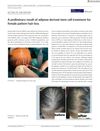 April 2021 in “Journal of Cosmetic Dermatology”
 Stem cell treatment improved hair density in female hair loss patient.
2 citations
,
May 2021 in “International journal of molecular sciences” Stem cells from hair follicles in a special gel show strong potential for bone regeneration.
 24 citations
,
January 2019 in “Biomaterials Science”
24 citations
,
January 2019 in “Biomaterials Science” The shape of fibrous scaffolds can improve how stem cells help heal skin.
16 citations
,
February 2013 in “Molecular Medicine Reports” CD34+ cells from fat tissue help form hair follicles and blood vessels in skin.
November 2015 in “Archivio Istituzionale della Ricerca (Universita Degli Studi Di Milano)” Platelet concentrates may help tissue regeneration and have potential for regenerative therapies.
60 citations
,
December 2020 in “Stem Cell Research & Therapy” ASC-CM is more effective than EV for treating osteoarthritis.
 9 citations
,
February 2021 in “Frontiers in Cell and Developmental Biology”
9 citations
,
February 2021 in “Frontiers in Cell and Developmental Biology” Older mice have stiffer skin with less elasticity due to changes in collagen and skin structure, affecting aging and hair loss.
 June 2026 in “International Science Journal”
 Tissue bioengineering and regenerative medicine are improving tissue restoration and recovery, with promising new therapies and personalized approaches.
 28 citations
,
April 2023 in “Stem cell research & therapy”
28 citations
,
April 2023 in “Stem cell research & therapy” Tiny vesicles from stem cells could be a new treatment for healing wounds.
 3 citations
,
March 2023 in “Life”
3 citations
,
March 2023 in “Life” Obesity can worsen wound healing by negatively affecting the function of stem cells in fat tissue.
 29 citations
,
March 2020 in “Stem Cell Research & Therapy”
29 citations
,
March 2020 in “Stem Cell Research & Therapy” Fat stem cells from diabetic mice can help heal skin wounds in other diabetic mice.
6 citations
,
April 2023 in “Cosmetics” Exosomes could be effective for improving skin health and treating skin diseases.
Low-level laser therapy may help stem cells grow and function better, aiding in healing and tissue repair.
 3 citations
,
January 2014 in “Elsevier eBooks”
3 citations
,
January 2014 in “Elsevier eBooks” Different stem cells have benefits and challenges for tissue repair, and more research is needed to find the best types for each use.