 21 citations
,
August 1991 in “The Journal of Dermatologic Surgery and Oncology”
21 citations
,
August 1991 in “The Journal of Dermatologic Surgery and Oncology” Using tissue expanders and hyaluronidase in scalp reduction surgery allows for more scalp removal and easier surgery.
 17 citations
,
January 1996 in “Aesthetic Plastic Surgery”
17 citations
,
January 1996 in “Aesthetic Plastic Surgery” The tumescent technique improves hair micrografting by providing lasting anesthesia, reducing bleeding, and increasing patient comfort.
 11 citations
,
July 2008 in “Facial Plastic Surgery Clinics of North America”
11 citations
,
July 2008 in “Facial Plastic Surgery Clinics of North America” Hair restoration surgery redistributes existing hair to achieve a natural look, with visible regrowth in 3-4 months and rare complications, mostly aesthetic.
 10 citations
,
January 2011 in “Journal of Cutaneous and Aesthetic Surgery”
10 citations
,
January 2011 in “Journal of Cutaneous and Aesthetic Surgery” Surgical methods for hair loss are less common than hair transplants but still useful, especially for scarring hair loss.
 8 citations
,
October 1988 in “Clinics in Dermatology”
8 citations
,
October 1988 in “Clinics in Dermatology” Current research explores hair growth drugs, while future research aims for personalized treatments.
 8 citations
,
June 1979 in “JAMA”
8 citations
,
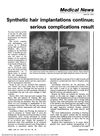
June 1979 in “JAMA” Synthetic hair implants can cause severe infections and are risky.
 7 citations
,
June 2004 in “Dermatologic Surgery”
7 citations
,
June 2004 in “Dermatologic Surgery” A new hair transplant method combines individual and group follicles for better results and efficiency.
 5 citations
,
May 2004 in “Dermatologic Surgery”
5 citations
,
May 2004 in “Dermatologic Surgery” A hair restoration technique was introduced that mixes different types of hair groupings to reduce procedure time, limit damage, and potentially increase hair density, suggesting more hair can be transplanted than previously thought.
 4 citations
,
October 2020 in “Journal of oral and maxillofacial surgery”
4 citations
,
October 2020 in “Journal of oral and maxillofacial surgery” Tisseel shows promise for bone graft stabilization but needs more clinical trials to confirm its effectiveness.
 3 citations
,
December 2008 in “The American Journal of Cosmetic Surgery”
3 citations
,
December 2008 in “The American Journal of Cosmetic Surgery” Hair transplantation has evolved to refined techniques like FUE and FUT, with Finasteride and Minoxidil as the only other proven treatments for hair loss.
 2 citations
,
November 2002 in “Dermatologic Surgery”
2 citations
,
November 2002 in “Dermatologic Surgery” The authors' 10-year experience shows that a personalized approach to hair restoration surgery, using various techniques, leads to natural results and high patient satisfaction.
 2 citations
,
June 1997 in “The American Journal of Cosmetic Surgery”
2 citations
,
June 1997 in “The American Journal of Cosmetic Surgery” Hair transplant megasessions are safe up to 1500 grafts but larger sessions have more risks and challenges.
 1 citations
,
March 1954 in “Archives of dermatology”
1 citations
,
March 1954 in “Archives of dermatology” Animal research has greatly advanced dermatology.
 November 2002 in “Dermatologic Surgery”
 Scalp reduction gives the most natural result for significant crown baldness, despite potential complications, and a systematic approach to surgical hair restoration results in few complications and high graft survival.
 September 2002 in “Dermatologic Surgery”
 The recipient site can affect the growth and survival of transplanted hair but not its thickness.
 May 1993 in “Medical Clinics of North America”
 Surgical hair replacement is a viable option for male pattern baldness when done with proper planning and realistic expectations.
 October 1987 in “Clinics in Dermatology”
 Scalp reduction can improve hair distribution in certain baldness cases but requires careful patient selection and understanding of facial structure.
Autologous Regenerative Therapy may improve hair restoration by using stem cells from fat.
 6 citations
,
August 2003 in “Aesthetic Surgery Journal”
6 citations
,
August 2003 in “Aesthetic Surgery Journal” Hair restoration using micrografts and minigrafts can provide natural-looking hair without scars and good density in 1 or 2 sessions.
Micrografts and minigrafts effectively treat male hair loss with natural-looking results.
11 citations
,
December 2010 in “American journal of transplantation” Some patients developed hair loss after islet cell transplant possibly due to their immune-suppressing medications.
September 2020 in “PubMed” The specialized protective cap improved recovery and satisfaction after hair transplant.
 15 citations
,
January 1999 in “Archives of Facial Plastic Surgery”
15 citations
,
January 1999 in “Archives of Facial Plastic Surgery” Advancements in hair transplantation have resulted in more natural-looking hair and increased patient satisfaction.
 9 citations
,
February 2013 in “Plastic and Reconstructive Surgery”
9 citations
,
February 2013 in “Plastic and Reconstructive Surgery” The article explains how to rebuild parts of the head and face and how to transplant hair to cover scars, highlighting the need for careful planning and choosing the right method for each patient.
10 citations
,
January 2015 in “PubMed” January 2008 in “Chinese Journal of Aesthetic and Plastic Surgery” Type B material, ground for 8 hours, is the most suitable and compatible for use as a soft tissue filler.
 January 2016 in “Hair transplant forum international”
 The key points for successful grafting are how the recipient site is prepared and how the graft is placed.
 January 2025 in “Advancements in Life Sciences”
 Autogenic and allogenic PRP effectively promote wound healing.
 2 citations
,
September 1996 in “The American Journal of Cosmetic Surgery”
2 citations
,
September 1996 in “The American Journal of Cosmetic Surgery” The authors suggest using a standard system to name hair grafts to improve communication in hair restoration.
2 citations
,
September 2023 in “Journal of clinical medicine” Scalp skin grafts effectively cover lower limb defects with high success and minimal complications.