18 citations
,
July 1998 in “Pediatric Dermatology” Monthly oral corticosteroid pulses effectively treat widespread alopecia areata in young patients.
11 citations
,
August 2016 in “Journal of the European Academy of Dermatology and Venereology” Serial trichoscopy is more reliable than the modified hair pull test for tracking alopecia areata.
10 citations
,
June 2019 in “Dermatologic therapy” DPCP alone is more effective and safer for treating chronic extensive alopecia areata than combining it with anthralin.
 10 citations
,
August 2018 in “Dermatologic Surgery”
10 citations
,
August 2018 in “Dermatologic Surgery” Laser treatment improves hair density and increases growth factors in androgenetic alopecia.
 9 citations
,
September 2019 in “Journal of Cosmetic Dermatology”
9 citations
,
September 2019 in “Journal of Cosmetic Dermatology” PRP injections improve hair density in male hair loss.
9 citations
,
July 2019 in “Dermatologic therapy” Alitretinoin can effectively treat frontal fibrosing alopecia.
9 citations
,
January 2019 in “Dermatology Online Journal” Laser-assisted delivery of PRP, with or without bimatoprost and minoxidil, can effectively stimulate hair growth.
 9 citations
,
March 1985 in “Head & Neck Surgery”
9 citations
,
March 1985 in “Head & Neck Surgery” Topical minoxidil is the most promising treatment for male pattern hair loss, but more research is needed to confirm its effectiveness and safety.
 7 citations
,
August 2021 in “Journal of the European Academy of Dermatology and Venereology”
7 citations
,
August 2021 in “Journal of the European Academy of Dermatology and Venereology” Early treatment of fibrosing alopecia in a pattern distribution may improve outcomes.
 5 citations
,
January 2020 in “Skin appendage disorders”
5 citations
,
January 2020 in “Skin appendage disorders” Oral dutasteride works better for hair loss, but has more sexual side effects; intralesional dutasteride is a possible alternative.
 4 citations
,
March 2022 in “Dermatology and Therapy”
4 citations
,
March 2022 in “Dermatology and Therapy” People with moderate hair loss from Alopecia Areata feel more impacted than those with no or almost complete hair loss, and are more likely to seek treatment.
 4 citations
,
May 2019 in “Journal of The European Academy of Dermatology and Venereology”
4 citations
,
May 2019 in “Journal of The European Academy of Dermatology and Venereology” Hair loss treatment caused more hair loss in a man.
 4 citations
,
July 2017 in “British Journal of Dermatology”
4 citations
,
July 2017 in “British Journal of Dermatology” The study identified the top 10 most important areas for future hair loss research.
 4 citations
,
March 2016 in “Dermatologic Surgery”
4 citations
,
March 2016 in “Dermatologic Surgery” PRP treatment increased hair density, especially in men and younger patients with AGA.
 3 citations
,
January 2022 in “Scientific Reports”
3 citations
,
January 2022 in “Scientific Reports” A new treatment called SAMiRNA-AR68 increases hair count in people with hair loss, showing similar results to existing treatments but without side effects.
2 citations
,
January 2022 in “Annals of Dermatology” Treatment type and patch size affect hair regrowth patterns in alopecia areata.
 2 citations
,
March 2021 in “Cosmetics”
2 citations
,
March 2021 in “Cosmetics” Hair transplant surgery is the most effective, safe, and satisfying treatment for hair loss.
 2 citations
,
January 2021 in “Przegląd Dermatologiczny (1959)”
2 citations
,
January 2021 in “Przegląd Dermatologiczny (1959)” The article discusses various treatments for different types of non-scarring hair loss.
2 citations
,
January 2019 in “The Journal of Korean Medicine Ophthalmology and Otolaryngology and Dermatology” Korean medical treatments are effective for alopecia areata, especially in less severe cases.
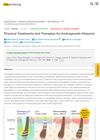
Low-level laser therapy is the most effective for hair loss, but other treatments also show promise.
1 citations
,
September 2023 in “Journal of the American Academy of Dermatology” Continued ritlecitinib treatment can lead to hair regrowth in some patients with alopecia areata who initially don't respond.
1 citations
,
December 2021 in “Journal of Cosmetic Dermatology” PRP treatment effectively reduces hair loss after COVID-19.
 1 citations
,
June 2017 in “Journal of The American Academy of Dermatology”
1 citations
,
June 2017 in “Journal of The American Academy of Dermatology” Topical treatment SM04554 safely promotes hair growth in male baldness.
 1 citations
,
June 2017 in “Journal of The American Academy of Dermatology”
1 citations
,
June 2017 in “Journal of The American Academy of Dermatology” PRP treatment for hair loss shows promise, with 58% of patients satisfied and most noticing improvement within 6 months.
 1 citations
,
April 2017 in “Journal of Investigative Dermatology”
1 citations
,
April 2017 in “Journal of Investigative Dermatology” SM04554 may increase hair growth as a topical treatment for androgenetic alopecia.
1 citations
,
November 2016 in “Journal of dermatological treatment” Oral tacrolimus may be a potential treatment for hair loss that doesn't respond to corticosteroids.
1 citations
,
January 2000 in “PubMed” The treatment slightly increased hair growth and was safe for most women.
July 2026 in “Research Society and Development” Early diagnosis and personalized treatments are key to improving hair loss therapies.
June 2026 in “Acta Dermato Venereologica” JAK inhibitors can help some people with long-standing alopecia areata regrow hair, but many stop treatment due to limited effectiveness.
June 2026 in “International Journal of Homoeopathic Sciences” Homeopathic treatment improved hair loss and scalp condition.