January 2025 in “Case Reports in Endocrinology” Accurate diagnosis of rare hyperandrogenism conditions requires detailed testing and sometimes invasive procedures.
 November 2022 in “The Journal of Clinical Endocrinology and Metabolism”
 Postmenopausal hyperandrogenism, a condition with symptoms like increased hair growth and acne, is usually caused by PCOS but can also be due to other factors. It's diagnosed by checking testosterone levels and treated either by removing the adrenal tumor or through antiandrogen therapy.
15 citations
,
May 2021 in “Climacteric” Postmenopausal hyperandrogenism involves excess male hormones causing symptoms like hair growth and acne, and requires ruling out tumors and other disorders.
January 2026 in “JCEM Case Reports” Benign conditions can mimic serious ones in postmenopausal hyperandrogenism, requiring careful diagnosis.
 35 citations
,
March 2012 in “Experimental and Clinical Endocrinology & Diabetes”
35 citations
,
March 2012 in “Experimental and Clinical Endocrinology & Diabetes” The conclusion is that accurately identifying the cause of high androgen levels in women with PCOS is crucial and requires specific tests.
January 2013 in “Obstetrical & gynecological survey” Most women with hirsutism have normal hormone levels and can be treated with cosmetic methods; obesity and PCOS are common causes, and treatments depend on the underlying issue.
 2 citations
,
November 2017 in “Journal of Endocrinological Investigation”
2 citations
,
November 2017 in “Journal of Endocrinological Investigation” The painting of an 18th-century Sicilian baroness shows she had hair loss, possibly due to ovarian issues, insulin resistance, or a specific type of tumor.
 42 citations
,
April 2013 in “Steroids”
42 citations
,
April 2013 in “Steroids” Non-classic congenital adrenal hyperplasia is a common disorder causing symptoms like acne and infertility, and it's managed based on symptoms, not just test results. Treatment can improve fertility and reduce miscarriage risk.
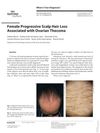 January 2019 in “Skin appendage disorders”
 A woman's hair loss was linked to a rare hormone-secreting ovarian tumor, treated with surgery and hair loss medication.
January 2020 in “International Journal of Trichology” Androgen-producing ovarian tumors can cause male-pattern hair loss in women.
 October 2023 in “Journal of the Endocrine Society”
 The document concludes that doctors should thoroughly check postmenopausal women with sudden increased male traits for rare conditions like androgen-producing endometrial cancer.
October 2025 in “Journal of the Endocrine Society” A postmenopausal woman had rare symptoms due to a possible ovarian tumor, needing thorough evaluation.
3 citations
,
May 2025 in “Clinical Endocrinology” Evaluate and manage androgen excess in women with a systematic approach, considering both physical and psychological impacts.
 1540 citations
,
October 2008 in “Fertility and Sterility”
1540 citations
,
October 2008 in “Fertility and Sterility” The report concludes that PCOS is mainly a condition of excess male hormones and its definition may change as new information is discovered.
 October 2020 in “Medicine - Programa De Formación Médica Continuada Acreditado”
 Female hyperandrogenism is a condition caused by too much male hormones, leading to skin issues and ovulation problems, often due to Polycystic Ovary Syndrome, and is treated based on individual symptoms.
 3 citations
,
November 2005 in “Women's health”
3 citations
,
November 2005 in “Women's health” Excessive body hair in women can be caused by various conditions and treated with medication like Diane® 35 or androgen blockers.
3 citations
,
January 2021 in “touchREVIEWS in Endocrinology” Surgery removed an ovarian tumor, improving her symptoms and normalizing testosterone levels.
 May 2023 in “IntechOpen eBooks”
 More research is needed to understand how testosterone is maintained in adult males.
1 citations
,
March 2012 in “Journal of pediatric & adolescent gynecology” A young girl with high testosterone was thought to have a tumor but actually had PCOS, which was treated with birth control pills.
 September 2024 in “Electronic Journal of General Medicine”
 Diagnosing Sertoli-Leydig cell tumors is challenging due to their unusual symptoms and can occur at any age.
 January 2024 in “Journal of surgical case reports”
 Removing an adrenal tumor can significantly reduce high androgen levels in postmenopausal women.
 4 citations
,
March 2021 in “Case Reports”
4 citations
,
March 2021 in “Case Reports” A woman's excessive hair growth and masculine features were due to a rare benign ovarian tumor and endometrial cancer, which improved after surgery.
 20 citations
,
October 2017 in “Clinical Endocrinology”
20 citations
,
October 2017 in “Clinical Endocrinology” The conclusion is that removing both ovaries is the best treatment for excess male hormones in postmenopausal women, with medication as another option, and managing insulin resistance is important for diagnosis and treatment.
 March 2023 in “Bagcılar medical bulletin”
 A young woman had a rare tumor causing high male hormone levels and symptoms like excessive hair and acne. After removing the tumor, her hormone levels returned to normal. Early diagnosis is important.
 4 citations
,
January 2019 in “Obstetrics & gynecology science”
4 citations
,
January 2019 in “Obstetrics & gynecology science” A PET-CT scan successfully located a hard-to-find Leydig cell tumor in a woman with hormonal symptoms.
 352 citations
,
January 2006 in “The Journal of Clinical Endocrinology and Metabolism”
352 citations
,
January 2006 in “The Journal of Clinical Endocrinology and Metabolism” Most women referred for excess male hormone symptoms had polycystic ovary syndrome (PCOS), with other conditions being less common.
 2 citations
,
November 2011 in “InTech eBooks”
2 citations
,
November 2011 in “InTech eBooks” Most adrenal cortex tumors are benign and non-secreting, but proper diagnosis and treatment are important due to the rare possibility of cancer.
 56 citations
,
October 2018 in “Journal of The American Academy of Dermatology”
56 citations
,
October 2018 in “Journal of The American Academy of Dermatology” Androgens play a complex role in skin conditions like acne and hair loss in women, and normal blood levels don't always show true androgen status.
 11 citations
,
January 2013 in “Indian Journal of Endocrinology and Metabolism”
11 citations
,
January 2013 in “Indian Journal of Endocrinology and Metabolism” A woman with a rare adrenal tumor and hormonal disorder had improved testosterone levels after surgery, but her menstrual irregularities continued.
 1 citations
,
September 2023 in “JCEM case reports”
1 citations
,
September 2023 in “JCEM case reports” GnRH analogues are effective for diagnosing and treating female androgen excess, offering a non-surgical option.