 85 citations
,
February 1989 in “Journal of The American Academy of Dermatology”
85 citations
,
February 1989 in “Journal of The American Academy of Dermatology” Children with loose anagen hair have easily pluckable hair due to root sheath problems, and it might improve without treatment.
 April 2024 in “Indian dermatology online journal”
 A rare hair follicle disorder can cause itchy, bluish-black bumps on the body.

The document concludes that dermatology training and grading scales need to better represent dark-skinned individuals to improve diagnosis and assessment of skin conditions.
6 citations
,
January 2013 in “Journal of Veterinary Medical Science” The dog's skin and anemia issues returned after stopping treatment for Babesia gibsoni.
1 citations
,
November 2025 in “Science Advances” Two gene variants cause white spots in cattle.
1 citations
,
January 2000 in “Indian Journal of Dermatology” A woman had hair loss and scalp nodules due to black piedra, confirmed by tests.
Hair ages by graying and thinning, treatable with medications, transplants, or hair dye.
 2 citations
,
June 2018 in “Clinical and Experimental Dermatology”
2 citations
,
June 2018 in “Clinical and Experimental Dermatology” Permanent hair loss after a stem cell transplant can be a sign of chronic immune system attack on the scalp.
7 citations
,
January 2008 in “Indian Journal of Dermatology” Pigmentary mosaicism causes skin color changes and can affect multiple body systems, but has no cure.
2 citations
,
May 2023 in “Indian Journal of Dermatology Venereology and Leprology” A new genetic mutation in the CAST gene may link PLACK syndrome to alopecia areata.
 January 2022 in “International journal of Ayurveda and pharma research”
 Premature graying of hair is linked to an imbalance of body energies in Ayurveda and treatment varies based on the specific imbalance.
 13 citations
,
July 2012 in “Pigment Cell & Melanoma Research”
13 citations
,
July 2012 in “Pigment Cell & Melanoma Research” A mutation in the Adam10 gene causes freckle-like spots on Hairless mice.
 January 2025 in “TURKDERM”
 Alopecia areata incognito in children can be effectively treated with triamcinolone acetonide and supplements, leading to full hair regrowth.
 November 2025 in “World Journal of Biology Pharmacy and Health Sciences”
 Premature greying in kids can signal health issues like vitamin deficiencies or thyroid problems, which can be treated.
 63 citations
,
December 1988 in “International Journal of Dermatology”
63 citations
,
December 1988 in “International Journal of Dermatology” Vitiligo causes white skin patches and is linked to autoimmune issues.
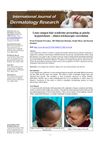 January 2026 in “International Journal of Dermatology Research”
 Early recognition of loose anagen hair syndrome is important to prevent misdiagnosis and unnecessary treatments.
4 citations
,
November 2019 in “Dermatology - Open Journal” Lichen planus pigmentosus is hard to treat and may be more common in North Africa than previously thought.
 June 2023 in “Romanian Medical Journal”
 The case shows how hard it is to tell apart Multiple Autoimmune Syndrome from other similar autoimmune conditions, but correct diagnosis is key for treatment to work.
January 2025 in “Medical Research Archives” A new classification and scoring system is needed for alopecia areata to better assess severity.
Some goats get rare skin diseases from not enough vitamin E, selenium, or zinc, but they're usually still healthy.
Visible lesions are not always needed to diagnose tinea capitis.
 October 2022 in “The Journal of Family Practice”
 Tinea capitis is a scalp fungal infection in children that can cause hair loss, scaling, and other symptoms.
August 2025 in “Indian Dermatology Online Journal” Early recognition and treatment of EPDS are crucial to prevent permanent hair loss.
 17 citations
,
June 2016 in “Croatian Medical Journal”
17 citations
,
June 2016 in “Croatian Medical Journal” Patients with chronic graft-versus-host disease often have skin problems like vitiligo and alopecia areata.
 January 2023 in “Indian dermatology online journal”
 Skin problems after waxing led to a sarcoidosis diagnosis.
 April 2018 in “Journal of Investigative Dermatology”
 The research found that a specific skin cell type not only triggers hair growth but also controls hair color, and that aging can lead to hair loss and color changes.
23 citations
,
October 1958 in “PubMed”  November 2025 in “Zenodo (CERN European Organization for Nuclear Research)”
 Identifying and treating deficiencies and conditions can stop or reverse premature greying in children.

Premature hair graying is common and linked to stress, obesity, vitamin deficiencies, family history, lack of exercise, smoking, and allergies.
 30 citations
,
December 2001 in “Experimental dermatology”
30 citations
,
December 2001 in “Experimental dermatology” Gonadal hormones significantly affect the severity of alopecia areata in mice.