13 citations
,
March 2008 in “Journal of the European Academy of Dermatology and Venereology” Triamcinolone acetonide therapy for hair loss may cause a skin condition called linear lichen planus.
 2 citations
,
August 2010 in “Journal of Scientific Research”
2 citations
,
August 2010 in “Journal of Scientific Research” The study found specific shape, size, and cellular details of Tridax procumbens leaves that can help identify the plant.
 August 2022 in “bioRxiv (Cold Spring Harbor Laboratory)”
 Mouse touch-sensitive nerve cells adjust their connections based on competition with other similar cells.
 5 citations
,
January 2019 in “Skin appendage disorders”
5 citations
,
January 2019 in “Skin appendage disorders” The conclusion is that it's important to tell apart alopecia areata from lipedematous alopecia for proper treatment, as alopecia areata can be reversed.
 July 2026 in “bioRxiv (Cold Spring Harbor Laboratory)”
 ACA2 is crucial for root hair growth by controlling calcium levels in cells.

Skin stem cells in hair follicles are important for touch sensation.

Meis2 is essential for touch sensation and proper nerve connection to touch receptors in certain skin areas of mice.
20 citations
,
January 2015 in “Biochimica and biophysica acta. Molecular and cell biology of lipids” Lysophosphatidic acid affects sensory neurons and may cause neuropathic pain and itch.
75 citations
,
July 2016 in “New phytologist” The protein RSL4 is crucial for making root hairs longer by controlling genes related to cell growth.
2 citations
,
July 2016 in “Veterinary dermatology” Hyperaesthetic leucotrichia in horses causes painful, recurring skin lesions and hair color changes, especially in Arabian and American paint horses.
7 citations
,
September 2024 in “PLANT PHYSIOLOGY” RALF22 is essential for root hair growth in response to fungal emissions in Arabidopsis.
 April 2023 in “The journal of investigative dermatology/Journal of investigative dermatology”
 Ritlecitinib significantly improves scalp hair regrowth in alopecia areata patients over time.
 September 2024 in “PubMed”
 Certain RNAs may help diagnose alopecia areata by affecting keratin genes.
RNase L hinders hair follicle regeneration by altering immune signals.
 July 2025 in “Communications Biology”
 Rat vibrissae structure relates to their sensory function.
2 citations
,
June 2025 in “Journal of Investigative Dermatology” CD8+ T cells re-expressing CD45RA may predict treatment resistance in severe alopecia areata.
20 citations
,
December 2010 in “Journal of Morphology” Lizard claws have hair-like keratins similar to those in mammals.
 September 2024 in “Skin Research and Technology”
 AFM can help diagnose lichen planopilaris by identifying specific hair structure changes.
 February 2025 in “Journal of Clinical Investigation”
 RNase L hinders hair growth by altering immune signals.
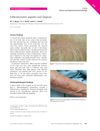 May 2014 in “Clinical and Experimental Dermatology”
 A 70-year-old woman with a rare skin condition improved after treatment with topical steroids and acitretin.
6 citations
,
May 2020 in “British Journal of Dermatology” Lichen Sclerosus causes itching, pain, and potential complications in the genital area.
63 citations
,
February 2010 in “Journal of Neurophysiology” Microstimulation of certain facial and mouth nerves can evoke specific sensations, while deeper nerves may require multiple stimulations to affect perception.
 46 citations
,
July 2007 in “Journal of comparative neurology”
46 citations
,
July 2007 in “Journal of comparative neurology” Manatee whiskers are specially adapted for touch in water.
 1 citations
,
December 2022 in “Pediatric dermatology”
1 citations
,
December 2022 in “Pediatric dermatology” A boy developed a rare skin condition after recovering from a severe skin reaction, and it improved with lotion treatment.
12 citations
,
September 1990 in “The Anatomical Record” Human anagen hair follicles have unique carbohydrate patterns during keratinization.
207 citations
,
September 1973 in “Entomologia Experimentalis et Applicata” B-type hairs on female butterfly legs help them choose where to lay eggs.
 March 2024 in “Journal of Applied and Natural Science”
 Mentha spicata leaves lower testosterone and aggression in female rats.
 November 2022 in “The journal of investigative dermatology/Journal of investigative dermatology”
 Researchers made a detailed map of gene activity for different parts of human hair follicles to help create targeted hair disorder treatments.
1 citations
,
March 2023 in “SKIN The Journal of Cutaneous Medicine” July 2024 in “Journal of Investigative Dermatology” CD8+ T cells expand significantly in alopecia areata, suggesting new treatment targets.