 February 2013 in “Journal of Visualized Experiments”
 The document's conclusion cannot be provided because the document is not available for analysis.
 January 2025 in “BMC Genomics”
 Key genes and RNA networks regulate hair growth and follicle density in Rex rabbits.
 102 citations
,
August 2008 in “Genes & Development”
102 citations
,
August 2008 in “Genes & Development” Laminin-511 is crucial for early hair growth and maintaining important hair development signals.
 1 citations
,
June 2021 in “bioRxiv (Cold Spring Harbor Laboratory)”
1 citations
,
June 2021 in “bioRxiv (Cold Spring Harbor Laboratory)” Activating β-catenin in mammary cells leads to changes that cause early-stage abnormal growths similar to skin structures.
 60 citations
,
November 2013 in “Development”
60 citations
,
November 2013 in “Development” Keratin 79 marks a new group of cells that are key for creating and repairing the hair follicle's structure.
15 citations
,
June 2012 in “British Journal of Dermatology” A new mutation in the KRT86 gene causes a hair disorder with variable expression.
January 2000 in “Medical Entomology and Zoology”  September 2020 in “bioRxiv (Cold Spring Harbor Laboratory)”
 Different fish use the same genes to regrow teeth.
Moderate immune responses help hair growth, while excessive responses slow it down.
47 citations
,
July 2023 in “Nature Genetics” 4 citations
,
December 2023 in “Medicine” Lower levels of MYLK and CALD1 in bladder cancer and osteosarcoma are linked to worse survival rates.
 November 1983 in “American Biology Teacher”
 Pattern baldness is likely caused by a dominant gene influenced by testosterone levels, making it more common in men.
70 citations
,
March 1997 in “Journal of Investigative Dermatology” 1 citations
,
January 2004 in “Adelaide Research & Scholarship (AR&S) (University of Adelaide)” SPARC likely aids in tissue remodeling during the hair cycle, not in starting new hair growth phases.
January 2025 in “SSRN Electronic Journal”  April 2023 in “The journal of investigative dermatology/Journal of investigative dermatology”
 DKK2 and SOSTDC1 together are necessary for the normal timing of the first regression phase in the hair growth cycle.
 April 2016 in “Journal of Investigative Dermatology”
 Sonic hedgehog signaling is needed for the development of touch-receptor cells in the skin, and the loss of Polycomb repressive complex 2 can lead to more of these cells.
 127 citations
,
December 2007 in “Journal of Investigative Dermatology”
127 citations
,
December 2007 in “Journal of Investigative Dermatology” Mice hair growth patterns get more complex with age and can change with events like pregnancy or injury.
 8 citations
,
February 2005 in “British Journal of Haematology”
8 citations
,
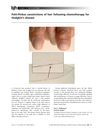
February 2005 in “British Journal of Haematology” Chemotherapy caused the patient's hair to have alternating thick and thin segments.
 130 citations
,
January 1994 in “Differentiation”
130 citations
,
January 1994 in “Differentiation” Mouse hair follicle cells briefly grow during the early hair growth phase, showing that these cells are important for starting the hair cycle.
 April 2026 in “bioRxiv (Cold Spring Harbor Laboratory)”
 The Lanyu pig's hair follicles are similar to human ones, making it useful for studying skin healing.
18 citations
,
July 2016 in “Genetica” BMP4 gene is crucial for hair follicle development in Liaoning cashmere goats.
59 citations
,
November 2011 in “Development” Trps1 is essential for proper hair follicle development.
September 2017 in “The journal of investigative dermatology/Journal of investigative dermatology” Male-pattern baldness has a weak link to heart disease and some related health conditions.
 7 citations
,
August 2017 in “PloS one”
7 citations
,
August 2017 in “PloS one” Key genes linked to hair growth and cancer were identified in hairless mice.
June 2026 in “bioRxiv (Cold Spring Harbor Laboratory)” The atlas maps human scalp cells, revealing insights into hair loss and potential treatments.
 April 2017 in “The journal of investigative dermatology/Journal of investigative dermatology”
 Astrotactin2 affects hair follicle orientation and skin cell polarity.
 January 2019 in “Proceedings for Annual Meeting of The Japanese Pharmacological Society”
 Nε-(carboxymethyl) lysine delays hair growth by blocking a key protein.
32 citations
,
September 1996 in “Archives of Dermatological Research” 6 citations
,
September 1996 in “Archives of Dermatological Research”