25 citations
,
January 1999 in “Journal of cutaneous laser therapy” Diode laser effectively treats pseudofolliculitis barbae.
96 citations
,
February 2002 in “Journal of the American Academy of Dermatology” Pseudofolliculitis barbae is a chronic skin condition affecting mainly African American and Hispanic individuals, caused by shaving tightly curled hair, and managed by prevention and treatment but not curable.
21 citations
,
June 2004 in “Experimental Dermatology” Ber‐EP4 marks cells related to the secondary hair germ in hair follicles.
1 citations
,
March 1991 in “PubMed” Naevoid bundle hair is an unusual hair growth pattern where multiple hairs fuse together.

Androgenetic alopecia (AGA) is a common, hereditary hair loss condition that can be slowed but not permanently reversed with available therapies.
 210 citations
,
July 1993 in “The journal of investigative dermatology/Journal of investigative dermatology”
210 citations
,
July 1993 in “The journal of investigative dermatology/Journal of investigative dermatology” Hair color production in mice is closely linked to the hair growth phase and may also influence hair growth itself.
 April 2018 in “The journal of investigative dermatology/Journal of investigative dermatology”
 Electrical epilation damages hair follicles and surrounding skin, likely preventing hair regrowth.
April 2023 in “The Medical Journal of Australia” A five-year-old girl has a harmless, unchanging bald patch on her scalp.
35 citations
,
January 1981  112 citations
,
July 1998 in “Journal of Investigative Dermatology”
112 citations
,
July 1998 in “Journal of Investigative Dermatology” Ruby laser pulses best destroy hair follicles during the growth phase and effectiveness varies with laser intensity; melanin is key for targeting, and timing treatments can improve results.
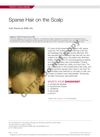
A 5-year-old girl has sparse, dry, and brittle hair but is otherwise healthy.
November 2013 in “Institutional Repositories DataBase (IRDB)” Gamma-ray exposure during hair rest phase harms hair growth and color in mice.
January 2019 in “日本皮膚科学会雑誌” 41 citations
,
September 2010 in “British journal of dermatology/British journal of dermatology, Supplement” Both intense pulsed light and long-pulsed diode laser effectively reduced facial hair in women, with no significant difference in satisfaction after 6 months, but intense pulsed light was more painful.
9 citations
,
July 1982 in “International Journal of Dermatology” A 31-year-old man's hair turned white suddenly, likely due to alopecia areata.
 4 citations
,
January 2002 in “Journal of Cosmetic Dermatology”
4 citations
,
January 2002 in “Journal of Cosmetic Dermatology” Long-pulsed ruby laser effectively reduces hair in male-to-female transsexuals.
January 2016 in “Case reports in clinical medicine” A 6-year-old girl was diagnosed with a rare hair disorder called monilethrix.
1 citations
,
December 1965 in “PubMed” 3 citations
,
March 2009 in “Hirosaki University Repository for Academic Resources (Hirosaki University)” Hirosaki hairless rats have sparse, twisted hair due to missing hair keratin genes.
June 2015 in “Obstetrics, gynaecology and reproductive medicine” Hirsutism, excessive hair growth in women, is often caused by polycystic ovarian syndrome and is treated by targeting the cause, lifestyle changes, and medication.
12 citations
,
December 2016 in “PubMed” Hirsutism involves excessive hair growth due to hormonal issues and can be treated with medication or surgery.
 3 citations
,
September 2019 in “Clinical and experimental dermatology”
3 citations
,
September 2019 in “Clinical and experimental dermatology” Basal cell carcinomas may differentiate similarly to hair follicles and could be influenced by hair cycle-related treatments.
December 1978 in “Indian Journal of Otolaryngology and Head & Neck Surgery” 23 citations
,
December 1977 in “Virchows Archiv B Cell Pathology” 
Daily hair care may cause holes in hair fibers.
September 2024 in “Journal of Ethnopharmacology” Terminalia bellirica extracts effectively promote hair regrowth and treat androgenetic alopecia.
December 2014 in “Actas dermo-sifiliográficas/Actas dermo-sifiliográficas” Hair removal with intense pulsed light can cause rare skin lesions that are hard to fully treat.
 35 citations
,
March 2007 in “Skin Research and Technology”
35 citations
,
March 2007 in “Skin Research and Technology” The conclusion is that exogen is a unique hair cycle phase and the new sampling method specifically targets this stage, which may help in future hair loss research.
46 citations
,
December 2000 in “Seminars in Cutaneous Medicine and Surgery” Laser and light treatments offer quick, long-lasting hair removal for large areas.
April 1986 in “CRC Press eBooks” Hair color is determined by melanins produced in hair cells.