 2 citations
,
January 2017 in “Recent clinical techniques, results, and research in wounds”
2 citations
,
January 2017 in “Recent clinical techniques, results, and research in wounds” Using tissue expanders with galeotomies for post-burn alopecia is faster and has fewer complications.
3 citations
,
May 2012 in “Journal of Biological Macromolecules” Keratin film can effectively mimic human hair for testing hair damage.
 21 citations
,
October 2017 in “Journal of Investigative Dermatology”
21 citations
,
October 2017 in “Journal of Investigative Dermatology” The document concludes that understanding dermal papilla cells is key to improving hair regeneration treatments.
May 2026 in “Waste and Biomass Valorization” 1 citations
,
January 2017 in “Elsevier eBooks” Functional materials in hair care improve shine, volume, frizz control, color protection, and repair.
 1 citations
,
September 2017 in “Journal of Investigative Dermatology”
1 citations
,
September 2017 in “Journal of Investigative Dermatology” Blocking a specific enzyme can reduce the negative impact of stress hormones on hair growth cells.
13 citations
,
August 2005 in “Journal of Investigative Dermatology Symposium Proceedings” Mutations in the DSG4 gene cause fragile, sparse hair in humans, mice, and rats.
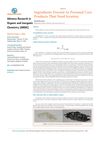
Certain ingredients in personal care products, like formaldehyde, oxidative hair dyes, and sulfates, pose health risks and need careful review.
June 2016 in “한국디자인문화학회지” UVA damages all hair types, especially permanently waved and colored hair.
 January 2007 in “Proceedings of the Korean Fiber Society Conference”
 New resin B makes artificial hair fibers hold curls longer than traditional resin A.
NaOH treatment improves hair strength and suitability for textiles.
March 2026 in “Health Science Reports” The 755 nm laser is more effective and safer for hair removal than the dual-wavelength laser.
January 2010 in “EPub Bayreuth (University of Bayreuth)” Polyquaternium-87 reduces hair friction the most among tested polymers.
23 citations
,
January 2016 in “Forensic Science International” Thermal hair straightening changes drug levels in hair, affecting test results.
July 2022 in “Siriraj Medical Bulletin” The conditioner effectively strengthens and smooths hair, offering a natural alternative.
November 2024 in “Biophysical Chemistry” Hair structure changes immediately during perm treatment, with initial damage partially restored later.
Acidic sandy clay damages archaeological hair the most, while dry conditions preserve but make it brittle; silicone oil can help keep the hair flexible.
 12 citations
,
January 2020 in “Analyst”
12 citations
,
January 2020 in “Analyst” Researchers found markers that can tell if hair has been bleached, which could improve hair test accuracy.
 June 2026 in “Lasers in Medical Science”
 Diode laser is more effective but more painful than intense pulsed light for hair removal.
July 2024 in “International Journal of Molecular Sciences” The inhibitor DPP can promote hair growth.
 May 1999 in “Hair transplant forum international”
 Hydrogen peroxide can affect wound healing.
1 citations
,
January 2010 in “Biological and medical physics series” Human hair's structure and properties were studied using advanced microscopes and mechanical tests.
Liquid nitrogen cryotherapy effectively promotes hair regrowth in alopecia areata.
3 citations
,
January 1985 in “Drug development and industrial pharmacy” Additives like ethanol and propylene glycol increase the release of zinc pyrithione from shampoo.
 13 citations
,
June 2007 in “Journal of Dermatological Science”
13 citations
,
June 2007 in “Journal of Dermatological Science” Researchers created a cell line to study hair growth and found specific genes affected by dihydrotestosterone.
2 citations
,
July 2021 in “Actas dermo-sifiliográficas/Actas dermo-sifiliográficas” Hair shaft disorders are diagnosed through examination and history, with general care and some treatments offering improvement.
 1 citations
,
September 2021 in “International journal of research - granthaalayah”
1 citations
,
September 2021 in “International journal of research - granthaalayah” Human hair has bipolar electrical charges because of a gap in the hair follicle's electromagnetic field.
October 2014 in “University of the Arts London Research Online (University of the Arts London)” Protein-derived ingredients can help strengthen bleached hair.
July 2021 in “British Journal of Dermatology” October 2018 in “Focus on surfactants”