 3 citations
,
April 2015 in “Cleveland Clinic Journal of Medicine”
3 citations
,
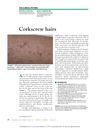
April 2015 in “Cleveland Clinic Journal of Medicine” The woman has scurvy and needs more vitamin C.
 March 2026 in “Cosmetics”
 Using enzymes with laser hair removal may reduce unwanted hair growth better than laser alone.
March 2024 in “Clinical Case Reports” Early detection of tinea capitis is possible by spotting specific hair patterns like comma or corkscrew hairs.
 May 2025 in “Journal of Cosmetic Dermatology”
 Cuticapil Stem Hair Serum improves hair growth and reduces shedding when added to minoxidil.
 October 2000 in “Pediatrics in Review”
 The document's conclusion cannot be summarized because the content is not available to parse.
17 citations
,
January 2015 in “JOURNAL OF CLINICAL AND DIAGNOSTIC RESEARCH” Cronkhite-Canada syndrome is a rare, non-inherited condition causing various symptoms like polyps, hair loss, and weight loss.
5 citations
,
October 2022 in “Biology” CAP1 helps Arabidopsis plants grow better under ammonium stress.
 January 2021 in “Mastology”
 Scalp cooling therapy helped over 80% of women keep at least half their hair during chemotherapy.
33 citations
,
November 2020 in “AAPS PharmSciTech” December 2025 in “Antibiotics” Tinea capitis in older adults is often misdiagnosed but can be effectively treated with antifungal therapy.
 March 2014 in “Journal of The American Academy of Dermatology”
 Cortexolone 17a-propionate may be an effective new treatment for hair loss.
 November 2009 in “Cambridge University Press eBooks”
 The document's conclusion cannot be provided because the content is not accessible.
November 2021 in “CRC Press eBooks” Tinea capitis is a fungal infection of the scalp that mainly affects children and can cause symptoms from mild itching to severe inflammation.
 April 2023 in “Journal of Investigative Dermatology”
 The document's conclusion cannot be provided because the content is not accessible.
 September 2024 in “Journal of the American Academy of Dermatology”
 The compounded topical solution is safe, stable, and effective for personalized alopecia treatment.
 January 2026 in “Supportive Care in Cancer”
 New cooling caps can help prevent hair loss from chemotherapy in a cost-effective and eco-friendly way.
September 2023 in “Zenodo (CERN European Organization for Nuclear Research)” The document's conclusion cannot be determined because the content is not available.

An adult Libyan woman was successfully treated for a rare scalp infection usually seen in children.
 1 citations
,
January 2003 in “Hair transplant forum international”
1 citations
,
January 2003 in “Hair transplant forum international” The document's conclusion cannot be provided because the document is not accessible or understandable.
16 citations
,
March 1991 in “International Journal of Dermatology” Tinea capitis is rare in healthy adults but should be considered in scalp issues.
 1 citations
,
January 2017 in “Journal of Community & Public Health Nursing”
1 citations
,
January 2017 in “Journal of Community & Public Health Nursing” Wearing a cap doesn't affect quality of life for Indian men with hair loss, but severe hair loss does lower it. Older men have more severe hair loss, and those who wear caps more often want less treatment.
 19 citations
,
July 2009 in “Clinical and Experimental Dermatology”
19 citations
,
July 2009 in “Clinical and Experimental Dermatology” The study found that long-term sun exposure does not significantly affect follicular plugs on the scalp, and the scalp's appearance is unique compared to other body parts.
 11 citations
,
December 1921 in “Archives of dermatology and syphilology”
11 citations
,
December 1921 in “Archives of dermatology and syphilology” A rare scalp disease causes hair loss, pus-filled nodules, and scarring.

Tinea capitis in adults often leads to misdiagnosis or delayed diagnosis due to atypical symptoms, requiring careful examination for proper treatment.
20 citations
,
July 1998 in “Archives of dermatology”  February 2024 in “Universal Library of Innovative Research and Studies”
 Proper placement, balanced strands, and high-quality polymers improve hair extension retention.
March 2019 in “Reactions Weekly”  July 1999 in “Hair transplant forum international”
 The document could not be read or understood.
24 citations
,
February 2002 in “The journal of investigative dermatology/Journal of investigative dermatology” Two new proteins, hKAP1.6 and hKAP1.7, are found in the hair follicle cortex.
May 2025 in “Biological and Clinical Sciences Research Journal” Minoxidil is more effective than Procapil for treating hair loss.