January 2004 in “Chinese Journal of Dermatology” Injecting specific oligonucleotides can change hair growth and structure by altering a gene.
33 citations
,
September 1990 in “Proceedings of the National Academy of Sciences” The study showed that a specific DNA sequence can control gene expression in hair growth areas of mice.
 6 citations
,
April 2025 in “Communications Biology”
6 citations
,
April 2025 in “Communications Biology” Monocytes in hair follicles help neutrophils move through the skin in contact dermatitis.
January 2024 in “Wiadomości Lekarskie” DEC cells show promise as a safe and effective treatment for Duchenne muscular dystrophy.
24 citations
,
March 2010 in “Journal of Cellular Biochemistry” Nestin-expressing blood vessels help skin transplants survive and heal.
2 citations
,
July 2022 in “Frontiers in Veterinary Science” A female dog with mixed male and female traits was treated successfully with surgery.

Infliximab was effective in treating a scalp condition that did not respond to other treatments.
January 2023 in “Journal of Plastic Surgery and Hand Surgery” Autogenic PRP improves graft viability more than xenogenic PRP, but both are effective.
 July 2024 in “Journal of Investigative Dermatology”
 Bioactive peptides improve graft survival and new hair growth.
 13 citations
,
March 1998 in “Journal of Biomedical Materials Research”
13 citations
,
March 1998 in “Journal of Biomedical Materials Research” Island grafts can help study skin regeneration separately from other healing processes.
October 2022 in “Hair Transplantation” Combination grafting offers efficient, natural hair restoration in one session.
32 citations
,
May 2023 in “Frontiers in Immunology” Understanding cellular interactions in VCA may lead to better treatments and reduce rejection.
2 citations
,
November 1996 in “Transplantation” Injecting recipient splenocytes into donors' thymus can prevent graft-versus-host disease.
47 citations
,
June 2013 in “Biology of blood and marrow transplantation” Mice with human fetal thymic tissue and stem cells developed symptoms similar to chronic graft-versus-host disease.
January 2011 in “Junshi yixue” A mouse model for studying scleroderma in chronic graft-versus-host disease was successfully created.
March 2026 in “Journal of Biomedical Materials Research Part B Applied Biomaterials” The scaffold improves wound healing and tissue regeneration.
 January 2015 in “D-Scholarship@Pitt (University of Pittsburgh)”
 Diabetic patients' stem cells make vascular grafts more prone to clots, but new methods may improve grafts.
December 2018 in “Dermatologic Surgery” Human amnion/chorion membrane and umbilical cord grafts may help heal scalp wounds with exposed bone.
 45 citations
,
October 2014 in “Stem cell research & therapy”
45 citations
,
October 2014 in “Stem cell research & therapy” Modified rat stem cells on a special scaffold improved blood vessel formation and wound healing in skin substitutes.
 19 citations
,
January 2007 in “Journal of medical investigation”
19 citations
,
January 2007 in “Journal of medical investigation” GFP transgenic mice help study cell origins in skin grafts.
38 citations
,
June 2016 in “Journal of Tissue Engineering and Regenerative Medicine” Microcolumn grafting can effectively regenerate full-thickness, functional skin without scarring.
Using regulatory T cells and Rapamycin together improves chronic graft-versus-host disease treatment outcomes in mice.
 57 citations
,
July 2018 in “Scientific Reports”
57 citations
,
July 2018 in “Scientific Reports” Using adipose tissue-derived fragments improves early skin graft success.
5 citations
,
November 2024 in “Biomedicine & Pharmacotherapy” The chitosan-peptide system helps cartilage regeneration using fat-derived cells.
 January 2016 in “Hair transplant forum international”
 The key points for successful grafting are how the recipient site is prepared and how the graft is placed.
 58 citations
,
April 2012 in “Journal of the American Academy of Dermatology”
58 citations
,
April 2012 in “Journal of the American Academy of Dermatology” Graft-versus-host disease is a complication where donor immune cells attack the recipient's body, often affecting the skin, liver, and gastrointestinal tract.
 5 citations
,
December 2011 in “Canadian Journal of Plastic Surgery”
5 citations
,
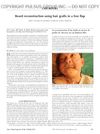
December 2011 in “Canadian Journal of Plastic Surgery” Hair grafts can successfully reconstruct a beard on reconstructed jaw skin, improving appearance and patient satisfaction.
 April 2019 in “Journal of Investigative Dermatology”
 Skin grafts from related donors significantly healed chronic wounds in patients with a severe skin condition over a year.
 January 2011 in “Plastic Surgery”
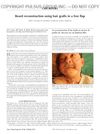
 Hair grafts successfully restored a realistic beard and hid scars, satisfying the patient.
 August 2004 in “Journal of the American College of Surgeons”
 Dermagraft and Dermalogen had a lot of granulation, while Alloderm, Integra, and ADM had good blood vessel growth for skin healing.