January 2009 in “Repositório Científico do Instituto Politécnico de Viseu (Instituto Politécnico de Viseu)” The skin lesion was diagnosed as a matrical cyst with unusual features.
 26 citations
,
August 2013 in “Australasian Journal of Dermatology”
26 citations
,
August 2013 in “Australasian Journal of Dermatology” Certain scalp patterns can indicate the severity and activity of hair loss in Turkish alopecia patients.
 1 citations
,
March 2024 in “Ophthalmic Plastic and Reconstructive Surgery”
1 citations
,
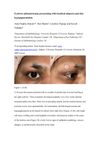
March 2024 in “Ophthalmic Plastic and Reconstructive Surgery” A pilomatrixoma in the eyebrow can cause hair loss and skin lightening.
August 2024 in “Skin Research and Technology” TAF can be identified by excessive skin thickening and clogged hair follicles, helping distinguish it from similar skin conditions.
 October 2021 in “Journal of Investigative Dermatology”
 Skin changes in Pseudoxanthoma elasticum patients can indicate the severity of related health issues.
 November 2023 in “International surgery journal”
 A man's neck lump was a trichilemmal cyst, not cancer, and should be fully removed due to rare risk of becoming malignant.
October 1991 in “Archives of Dermatology” The woman has a skin condition involving nodules, scars, and hair loss.
Tricholemmoma is linked to Cowden syndrome and can be benign or malignant.
 2 citations
,
January 2011 in “Dermatologica Sinica”
2 citations
,
January 2011 in “Dermatologica Sinica” Taiwan reported its first case of a rare scalp condition with no clear cause or treatment.
 January 2022 in “Consultant”
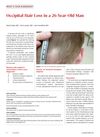
 The man's occipital hair loss was due to temporal triangular alopecia, not alopecia areata.
 September 2022 in “The American journal of dermatopathology/American journal of dermatopathology”
 A patient with a thick scalp and hair loss was correctly diagnosed with alopecia areata and a thick scalp fat layer, not lipedematous alopecia, and regrew hair after treatment.
June 2020 in “bioRxiv (Cold Spring Harbor Laboratory)” Stem and progenitor cells in the eye have different division rates and locations, affecting how they respond to injury.
2 citations
,
January 2018 in “PubMed” The man's symptoms improved and the tumor shrank after treatment with cabergoline.
23 citations
,
January 1985 in “Journal of Neuropathology & Experimental Neurology” Cupric chloride treatment corrected abnormal Purkinje cell development in brindled mice.
 January 2011 in “Journal of The American Academy of Dermatology”
 Two patients had a rare combination of red skin spots and white scaly skin lesions not on the genitals.
21 citations
,
April 2000 in “Journal of Cutaneous Pathology” The hamartoma is an abnormal hair growth with limited development in the upper hair follicle.
 November 2023 in “International Journal of Trichology”
 Trichoscopic features help diagnose and assess female pattern hair loss severity, with inflammation playing a key role.

A 73-year-old woman's unusual hair loss and growth led to the discovery of a rare condition causing too much testosterone, which improved after her ovaries were removed.
 January 2025 in “International Journal of Dermatology”
 Consider TFI in facial hypopigmentation diagnoses and confirm with a biopsy.
 January 2025 in “JCEM Case Reports”
 Ketoconazole improved symptoms of ACTH-independent Cushing syndrome despite inconclusive initial scans.
 January 2020 in “Medpulse International Journal of General Medicine”
 Trichoscopy helps diagnose and monitor hair loss, showing different signs at various stages of hair thinning.
 21 citations
,
January 2005 in “Pediatric Dermatology”
21 citations
,
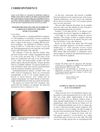
January 2005 in “Pediatric Dermatology” An 8-year-old girl with vitiligo developed extra hair growth on her knee after using tacrolimus ointment.
 18 citations
,
March 2011 in “Archives of ophthalmology”
18 citations
,
March 2011 in “Archives of ophthalmology” Ringworm around the eyes often gets misdiagnosed, leading to eyelash loss, but antifungal treatment can improve the condition.
January 2015 in “프로그램북(구 초록집)” Trichoscopy effectively diagnoses and assesses hair loss severity in androgenetic alopecia and alopecia areata.
21 citations
,
August 2002 in “British Journal of Ophthalmology” Intralesional cidofovir may be a viable alternative treatment for SCC.
 4 citations
,
January 2012 in “Springer eBooks”
4 citations
,
January 2012 in “Springer eBooks” The document concludes that signs of male and female pattern baldness include uneven hair thickness, yellow spots, skin discoloration around hair follicles, more thin and soft hairs, and many hair follicles with just one hair.
10 citations
,
September 1994 in “International Journal of Dermatology” Three Iranian men had reddish-brown facial pigmentation with no effective treatment.
 September 2023 in “Zenodo (CERN European Organization for Nuclear Research)”
 Trichoscopy helps diagnose and track treatment for hair loss in men and women.
3 citations
,
May 2024 in “BMC Medical Genomics” A new ARID1B gene variation causes Coffin-Siris syndrome 1 and early high myopia in a Chinese family.
3 citations
,
January 1989 in “The Nishinihon Journal of Dermatology” A hair cyst can become cancerous, showing specific keratins from the hair sheath.