 9 citations
,
August 2024 in “Tissue Engineering and Regenerative Medicine”
9 citations
,
August 2024 in “Tissue Engineering and Regenerative Medicine” Collagen-heparin-FGF2-VEGF scaffolds can improve skin healing.
 9 citations
,
January 1997 in “Endocrine Journal”
9 citations
,
January 1997 in “Endocrine Journal” Gonadal biopsy is the best method to diagnose gonadal dysgenesis.
 8 citations
,
April 2016 in “Anais Brasileiros De Dermatologia”
8 citations
,
April 2016 in “Anais Brasileiros De Dermatologia” Right hand finger ratio may predict male hair loss.
 5 citations
,
December 2004 in “Dermatology”
5 citations
,
December 2004 in “Dermatology” Two women with very high androgen levels had only slight skin issues, one due to a non-classical adrenal disorder and the other due to an adrenal tumor.
 4 citations
,
April 2021 in “Experimental and Molecular Medicine”
4 citations
,
April 2021 in “Experimental and Molecular Medicine” The conclusion is that certain genetic factors and blood types may affect COVID-19 severity, but changes in ACE2 and TMPRSS2 genes are not clearly linked to it.
 4 citations
,
July 2020 in “Biochemical and Biophysical Research Communications”
4 citations
,
July 2020 in “Biochemical and Biophysical Research Communications” A protein called ectodysplasin-A2 increases a hair growth inhibitor in balding cells, which could be a target for hair loss treatment.
 4 citations
,
November 2014
4 citations
,
November 2014 The skin protects the body, regulates temperature, senses touch, and makes vitamin D.
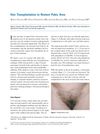 4 citations
,
February 2008 in “Dermatologic Surgery”
4 citations
,
February 2008 in “Dermatologic Surgery” Hair transplant surgery successfully restored a woman's pubic hair, improving her appearance and satisfaction.
 4 citations
,
October 1988 in “Clinics in Dermatology”
4 citations
,
October 1988 in “Clinics in Dermatology” Dihydrotestosterone (DHT) is crucial for conditions like male-pattern baldness and acne, and measuring a byproduct, androstanediol glucuronide, is a better way to assess DHT's effects than DHT blood levels.
 2 citations
,
February 2019 in “bioRxiv (Cold Spring Harbor Laboratory)”
2 citations
,
February 2019 in “bioRxiv (Cold Spring Harbor Laboratory)” The Asiatic lion has very low genetic diversity and unique genetic traits, highlighting the need for its conservation.
 2 citations
,
March 2011 in “Infertility”
2 citations
,
March 2011 in “Infertility” The conclusion is that lifestyle changes and weight loss are first-line treatments for infertility due to anovulation, with various medications and assisted reproductive technologies as additional options.
 1 citations
,
November 2018 in “Journal of pathology and translational medicine”
1 citations
,
November 2018 in “Journal of pathology and translational medicine” Fetal death was caused by umbilical cord stricture with hair growth in the Wharton jelly.
 1 citations
,
January 2017 in “Tohoku journal of experimental medicine”
1 citations
,
January 2017 in “Tohoku journal of experimental medicine” A woman's mature cystic teratoma caused her virilization by producing testosterone.
 1 citations
,
September 2015 in “Serbian Journal of Dermatology and Venereology/Serbian Journal of Dermatology and Venerology”
1 citations
,
September 2015 in “Serbian Journal of Dermatology and Venereology/Serbian Journal of Dermatology and Venerology” A 19-year-old male had two rare skin conditions causing scarring and permanent hair loss.
 1 citations
,
August 2011 in “Dermatology Reports”
1 citations
,
August 2011 in “Dermatology Reports” Two siblings were found to have a genetic condition causing progressive hair loss and woolly hair, which may often be misdiagnosed.
 1 citations
,
November 1995 in “Postgraduate medical journal”
1 citations
,
November 1995 in “Postgraduate medical journal” A Saudi individual initially identified as a girl had a genetic disorder affecting gender development.
 July 2025 in “International Journal of Dermatology Venereology and Leprosy Sciences”
 Examining Survivin levels may help understand premature greying of hair.
 December 2024 in “Turkish Journal of Forensic Medicine”
 Next-Generation Sequencing improves forensic analysis by providing detailed genetic information quickly.
 March 2024 in “medRxiv (Cold Spring Harbor Laboratory)”
 Recent selection on immune response genes was identified across seven ethnicities.
 April 2023 in “Medizinische Genetik”
 New research has found 14 genes linked to the risk of developing alopecia areata, improving understanding and treatment options.
 May 2018 in “European Journal of Dermatology”
 The first Japanese family with Marie Unna hereditary hypotrichosis showed hair condition improvement in a child and highlighted the risk of misdiagnosis.
 January 2018 in “General internal medicine and clinical innovations”
 Busulfan/cyclophosphamide and total bone irradiation are equally effective for AML transplants.
 May 2017 in “American Society of Health-System Pharmacists eBooks”
Skin changes throughout life, from development before birth to aging effects like wrinkles, influenced by both genetics and environment.
 March 2014 in “Journal of the American Academy of Dermatology”
 Alopecia areata is relatively common in children, has a variable course, and shows different responses to treatment; thyroid testing is recommended for those affected.
 January 2012 in “S. Karger AG eBooks”
 The document concludes that transsexual individuals often experience improved quality of life after transitioning, despite higher risks of psychiatric issues and mortality.
 February 2010 in “ePrints Soton (University of Southampton)”
 Male sexual differentiation is regulated independently, while female differentiation occurs in an androgenic environment, affecting conditions like congenital adrenal hyperplasia.
Treatments for acute leukaemia lead to high remission rates, but relapses occur, requiring ongoing advancements in care.
 August 1986 in “Journal of The American Academy of Dermatology”
 Minoxidil showed a 30% success rate for hair growth in a study, and various skin treatments were effective, but some had limitations or side effects.
 April 1974 in “Pediatric Research”
 The Naked (N) trait in mice is linked to lower glycine and tyrosine in hair proteins.