4 citations
,
January 2020 in “Dermatology Online Journal” Congenital atrichia with papular lesions causes permanent hair loss and skin bumps due to a gene mutation.
 4 citations
,
January 2014 in “International Journal of Trichology”
4 citations
,
January 2014 in “International Journal of Trichology” A 12-year-old boy with a rare genetic condition has progressive hair loss with no effective treatment.
4 citations
,
January 2013 in “International Journal of Trichology” Monilethrix has no effective treatment, but avoiding hair trauma helps manage it.
3 citations
,
February 2001 in “British journal of ophthalmology” An Australian with rare hair loss and eye conditions had a gene linked to both, not seen together before.
 2 citations
,
April 2010 in “The Open Dermatology Journal”
2 citations
,
April 2010 in “The Open Dermatology Journal” Corneodesmosin is essential for skin and hair health, and its dysfunction can lead to skin and hair disorders.
1 citations
,
January 2013 in “Indian journal of dermatology, venereology, and leprology” A girl inherited excessive body hair from her mother and grandmother.
 1 citations
,
May 2009 in “Annales de Dermatologie et de Vénéréologie”
1 citations
,
May 2009 in “Annales de Dermatologie et de Vénéréologie” Environmental factors like smoking, UV exposure, and poor diet contribute to hair loss and graying, and lifestyle changes can help manage it.
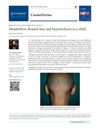 January 2026 in “Cosmoderma”
 A 9-year-old girl has a rare hair disorder causing beaded, sparse hair.
 April 2024 in “International Journal of Advanced Multidisciplinary Research and Studies”
 Early investigation and a team approach are crucial for managing primary amenorrhea effectively.
 March 2024 in “Tissue and cell/Tissue & cell”
 Telomerase-positive cells are mainly in the bulb matrix and outer root sheath of hair follicles.
 December 2022 in “Curēus”
 Genetic testing confirmed a young girl has Atrichia with Papular Lesions due to mutations in the hairless gene.
 August 2021 in “Research Square (Research Square)”
 StemMACS media is better for growing therapeutic stem cells.
 April 2020 in “International journal of research in dermatology”
 An 8-year-old girl has a rare, irreversible hair loss condition caused by a genetic mutation.
June 2017 in “Mechanisms of development” Hox genes control hair follicle stem cell regeneration in different body regions.
Deleting the MAD2L1 gene is tolerated in certain mouse cancer models.
 December 2016 in “Int J Genet”
 Male pattern baldness is partly caused by specific genes, but most genetic factors are still unknown.
Deleting the MAD2L1 gene in mice led to rapid tumor growth despite chromosomal instability.
 April 2016 in “Journal of The American Academy of Dermatology”
 People with Down syndrome are more likely to experience hair loss, and using dermoscopy can help diagnose it.
 December 2013 in “Appetite”
 A defective gene causes hair loss and taste insensitivity in BTBR mice.
 May 2012 in “Nature Genetics”
 Blond hair in Solomon Islanders is due to a unique genetic variant, not European ancestry.
September 2009 in “Hair transplant forum international” Genetic testing can help understand male pattern baldness.
 November 2022 in “Journal of the Endocrine Society”
 A boy with a new NR5A1 gene mutation has a sex development disorder without affecting his adrenal glands.
 50 citations
,
March 2001 in “Clinics in Dermatology”
50 citations
,
March 2001 in “Clinics in Dermatology” Genes and hormones cause hair loss, with four genes contributing equally.
 40 citations
,
June 2013 in “Scientific Reports”
40 citations
,
June 2013 in “Scientific Reports” A gene variant in KRT71 causes the curly fur in Selkirk Rex cats.
 37 citations
,
October 2015 in “European Journal of Human Genetics”
37 citations
,
October 2015 in “European Journal of Human Genetics” Genetic data can predict male-pattern baldness with moderate accuracy, especially for early-onset cases in some European men.
24 citations
,
January 2018 in “Indian Journal of Dermatology, Venereology and Leprology” Androgenetic alopecia is mainly caused by genetic factors and increased androgen activity, leading to hair follicle miniaturization.
 9 citations
,
September 2015 in “Reproductive Biomedicine Online”
9 citations
,
September 2015 in “Reproductive Biomedicine Online” Longer GGN repeats in the androgen receptor gene are linked to polycystic ovary syndrome.
7 citations
,
July 2018 in “Stem cell research” Hair samples can be used to create stem cells easily and non-invasively.
 4 citations
,
December 2012 in “Human Biology”
4 citations
,
December 2012 in “Human Biology” The most different genetic segment between Africans and East Asians is the EDA2R/AR region, with two main types influenced by population changes and natural selection, and linked to baldness.
 2 citations
,
October 2020 in “Annals of Oncology”
2 citations
,
October 2020 in “Annals of Oncology” Men may be more vulnerable to severe COVID-19 due to genetic and hormonal factors, but more research is needed.