95 citations
,
October 2007 in “International Journal of Dermatology” A new method accurately classifies hair types, showing global hair diversity.
2 citations
,
June 2012 in “American Journal of Dermatopathology” A rare neck cyst in a 47-year-old man showed diverse skin cell types and was not linked to HPV.
January 2006 in “International water power & dam construction” Nevus comedonicus can appear later in life and affect both eyelids.
17 citations
,
January 2023 in “Frontiers in Bioengineering and Biotechnology” The sponges effectively prevent dry socket by stopping bleeding and killing bacteria after tooth extraction.
58 citations
,
November 1969 in “British Journal of Dermatology” Netherton's disease causes multiple hair defects.
6 citations
,
January 2018 in “Advances in experimental medicine and biology” June 2026 in “BULLETIN OF STOMATOLOGY AND MAXILLOFACIAL SURGERY” Keratoacanthoma should be accurately diagnosed and treated based on its characteristics, often using surgery or tissue-preserving methods.
January 2007 in “Linchuang pifuke zazhi” A 15-year-old boy had a rare skin growth on his buttock.
December 2019 in “The American Journal of Gastroenterology” Small bowel lesions in Cronkhite-Canada syndrome persist despite steroid treatment.
May 2006 in “The American journal of medicine” The man had persistent itchy bumps on his cheeks and neck despite trying different shaving products.
11 citations
,
March 2004 in “Journal of Comparative Pathology” Norfolk Terriers have a genetic skin defect causing scaling and blisters due to a keratin issue.
 6 citations
,
February 2020 in “Journal of Natural Products”
6 citations
,
February 2020 in “Journal of Natural Products” A new compound from a sponge strongly inhibits an enzyme linked to male-pattern hair loss without being toxic at low levels.
55 citations
,
November 2010 in “Development” Hair follicles in mutant mice self-organize into ordered patterns within a week.
 1 citations
,
January 2018 in “Acta dermato-venereologica”
1 citations
,
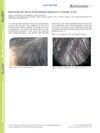
January 2018 in “Acta dermato-venereologica” A teenager's hair with alternating white and dark bands, known as Pili annulati, is a genetic condition that is usually harmless and often considered attractive.
 5 citations
,
March 2009 in “Pediatric Dermatology”
5 citations
,
March 2009 in “Pediatric Dermatology” The study found that pili bifurcati causes hair to intermittently split into two branches, each with its own outer layer.
75 citations
,
September 2007 in “Journal of Heredity” FGF5 gene mutations cause long hair in domestic cats.
33 citations
,
September 1987 in “American Journal of Medical Genetics” Uncombable hair is inherited dominantly with complete penetrance.
 20 citations
,
September 2021 in “Nature communications”
20 citations
,
September 2021 in “Nature communications” Cat color patterns are determined early in development by gene expression and epidermal changes, with the Dickkopf 4 gene playing a crucial role.
3 citations
,
January 2013 in “Journal of cosmetics, dermatological sciences and applications” HAIRCARECUBE TM (HCC) helps hair products work better by getting active ingredients deeper into the hair.
 February 2019 in “bioRxiv (Cold Spring Harbor Laboratory)”
 The gene Prss53 affects hair shape and bone development in rabbits.
264 citations
,
October 1958 in “Archives of Dermatology” A 4-year-old girl has a rare hair condition causing fragile, short hair.
 40 citations
,
February 1990 in “Journal of The American Academy of Dermatology”
40 citations
,
February 1990 in “Journal of The American Academy of Dermatology” A 17-year-old developed woolly hair nevus in adolescence, which is unusual, and over time the hair darkened and straightened slightly, but microscopic changes persisted.
 April 2025 in “Scholars International Journal of Anatomy and Physiology”
 Straight-lined hairlines are most common among Etche people.
 9 citations
,
February 2022 in “Archives animal breeding/Archiv für Tierzucht”
9 citations
,
February 2022 in “Archives animal breeding/Archiv für Tierzucht” A circular RNA helps cashmere goat hair cells become hair follicles by blocking a molecule to boost a gene important for hair growth.
July 2020 in “Research Square (Research Square)” A 3D co-culture model improved stem cell function and wound healing.
 August 2025 in “Biomacromolecules”
 The hydrogel dressing improves wound healing, offers long-lasting antibacterial effects, and enhances patient comfort.
27 citations
,
December 1997 in “Archives of Dermatological Research” Rat dermal papilla cells have unique properties and interact differently with their environment compared to other skin cells.
20 citations
,
April 2009 in “Cell Biology International” Hair follicle stem cells can become corneal-like cells with the help of pax6.
54 citations
,
January 2009 in “Development” β-catenin, Shh, and Bmp signaling control hair follicle development.
January 2026 in “SSRN Electronic Journal”