124 citations
,
April 1992 in “Journal of Endocrinology/Journal of endocrinology” Beard hair follicles have more androgen receptors than non-balding scalp hair follicles.
27 citations
,
December 1997 in “Archives of Dermatological Research” Rat dermal papilla cells have unique properties and interact differently with their environment compared to other skin cells.
 24 citations
,
February 2006 in “Chinese Medical Journal”
24 citations
,
February 2006 in “Chinese Medical Journal” Cultured dermal papilla cells can regenerate hair follicles and sustain hair growth.
January 2006 in “Chinese Journal of Dermatology” Cultured dermal papilla cells can regenerate hair follicles and sustain hair growth.
 10 citations
,
June 2019 in “Journal of Tissue Engineering and Regenerative Medicine”
10 citations
,
June 2019 in “Journal of Tissue Engineering and Regenerative Medicine” Scientists successfully grew new hair follicles in regenerated mouse skin using mouse and human cells.
 208 citations
,
December 2003 in “Journal of Investigative Dermatology”
208 citations
,
December 2003 in “Journal of Investigative Dermatology” Certain cells from hair follicles can create new hair and contribute to hair growth when implanted in mice.
 58 citations
,
March 2019 in “Experimental Dermatology”
58 citations
,
March 2019 in “Experimental Dermatology” Exosomes from human skin cells can stimulate hair growth and could potentially be used for treating hair loss.
 13 citations
,
October 2017 in “Bioscience, Biotechnology, and Biochemistry”
13 citations
,
October 2017 in “Bioscience, Biotechnology, and Biochemistry” Centella asiatica extract may help promote hair growth by blocking a specific cell signaling pathway.
 1 citations
,
January 2019 in “Annals of dermatology/Annals of Dermatology”
1 citations
,
January 2019 in “Annals of dermatology/Annals of Dermatology” STAT5 is crucial for hair growth in 3D cultured human dermal papilla cells.
January 2006 in “中华医学杂志:英文版” Cultured skin cells can trigger hair growth and the amount of certain proteins they produce affects their ability to regenerate hair follicles.
32 citations
,
February 2002 in “Veterinary Dermatology” Canine dermal papilla cells and fibroblasts have distinct growth patterns and protein expressions.
 November 2022 in “Journal of Investigative Dermatology”
 Growing dermal papilla cells in 3D improves their ability to help form new blood vessels.

The review suggested the study needed to clarify its purpose, compare with non-immortalized cells, and provide more details on methods.
 256 citations
,
October 2013 in “Proceedings of the National Academy of Sciences of the United States of America”
256 citations
,
October 2013 in “Proceedings of the National Academy of Sciences of the United States of America” Growing human skin cells in a 3D environment can stimulate new hair growth.
 10 citations
,
January 2016 in “Annals of Dermatology”
10 citations
,
January 2016 in “Annals of Dermatology” 3D-cultured dermal papilla cells are better at inducing hair follicles than adipose-derived stem cells.
 1 citations
,
April 2017 in “Journal of Investigative Dermatology”
1 citations
,
April 2017 in “Journal of Investigative Dermatology” CCL5 is important for the hair growth potential of human dermal papilla cells.
20 citations
,
August 1997 in “PubMed” Increased K+ permeability alone may not promote hair growth.
 9 citations
,
June 2020 in “BMC Molecular and Cell Biology”
9 citations
,
June 2020 in “BMC Molecular and Cell Biology” Stress hormone CRF can cause hair loss by affecting hair growth cells and hormones.
 May 2020 in “Research Square (Research Square)”
 Stress hormone CRF causes hair loss and inhibits hair growth in human cells.
 January 2020 in “Research Square (Research Square)”
 Stress hormone CRF causes hair loss and stops hair cell growth.
 April 2018 in “Journal of Investigative Dermatology”
 Removing STAT5 from 3D-cultured human skin cells reduces their ability to grow hair.
 September 2019 in “Journal of Investigative Dermatology”
 Dermal Papilla Cells grown in 3D and with stem cells better mimic natural hair growth conditions than cells grown in 2D.
 August 2016 in “Journal of Investigative Dermatology”
 DHT reduces a cell's ability to promote hair growth, while 3D culture without DHT improves it.
30 citations
,
November 2020 in “Journal of Advanced Research” Conditioned medium from keratinocytes can improve hair growth potential in cultured dermal papilla cells.
 1 citations
,
January 2023 in “Burns and trauma”
1 citations
,
January 2023 in “Burns and trauma” Tiny particles from 3D-grown skin cells speed up wound healing by promoting blood vessel growth.
 March 2014 in “Chinese Journal of Dermatology”
 Hair loss in androgenic alopecia patients is linked to changes in certain genes that control cell growth and death.
 October 2013 in “Faculty Opinions – Post-Publication Peer Review of the Biomedical Literature”
 Three-dimensional culture helps dermal papilla cells grow new human hair follicles.
March 2022 in “Molecules” Adenosine can help treat hair loss by promoting hair growth.
 75 citations
,
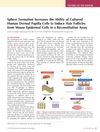
August 2011 in “Journal of Investigative Dermatology”
75 citations
,
August 2011 in “Journal of Investigative Dermatology” Forming spheres boosts the ability of certain human cells to create hair follicles when mixed with mouse skin cells.
 16 citations
,
October 2019 in “Biological & Pharmaceutical Bulletin”
16 citations
,
October 2019 in “Biological & Pharmaceutical Bulletin” Houttuynia cordata extract may help hair grow by improving cell survival and increasing cell growth.