660 citations
,
December 2011 in “Cell” Different hair follicles in the skin are innervated by unique combinations of mechanosensory neurons, crucial for touch sensation.
 4 citations
,
January 2015 in “Sen'i Gakkaishi”
4 citations
,
January 2015 in “Sen'i Gakkaishi” Hair and wool strength is affected by the number and type of bonds in their protein structures, with hair having more protein aggregates than wool.
3 citations
,
December 2004 in “PubMed” A fungal infection caused skin lesions in farmed mink kits, but they remained healthy.
 20 citations
,
September 2021 in “Nature communications”
20 citations
,
September 2021 in “Nature communications” Cat color patterns are determined early in development by gene expression and epidermal changes, with the Dickkopf 4 gene playing a crucial role.
 113 citations
,
March 2018 in “Biological reviews/Biological reviews of the Cambridge Philosophical Society”
113 citations
,
March 2018 in “Biological reviews/Biological reviews of the Cambridge Philosophical Society” Animals that change color with the seasons mainly do so in response to daylight changes, but climate change is causing camouflage problems that may require evolutionary changes.
June 2018 in “Journal of the American Veterinary Medical Association” Three related Persian cats have a rare, likely hereditary skin condition causing hair loss and poor coat quality, with limited treatment options.
July 2026 in “Indian Journal of Dermatology Venereology and Leprology” July 1993 in “Journal of Radioanalytical and Nuclear Chemistry” Mouse hair element patterns vary, making it unreliable for tracking time.
 41 citations
,
June 2013 in “PLOS ONE”
41 citations
,
June 2013 in “PLOS ONE” Engineered skin substitutes can grow hair but have limitations like missing sebaceous glands and hair not breaking through the skin naturally.
79 citations
,
October 1998 in “Genomics” Mouse keratin 6 genes evolved independently from human ones and are regulated differently.
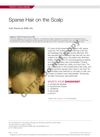
A 5-year-old girl has sparse, dry, and brittle hair but is otherwise healthy.
 111 citations
,
January 2007 in “Seminars in cell & developmental biology”
111 citations
,
January 2007 in “Seminars in cell & developmental biology” Hair, teeth, and mammary glands develop similarly at first but use different genes later.
 7 citations
,
July 2019 in “The Journal of Dermatology”
7 citations
,
July 2019 in “The Journal of Dermatology” Terbinafine effectively treated kerion celsi despite disrupted immune responses.
53 citations
,
August 2010 in “Molecular Carcinogenesis” Slug is crucial for skin health, hair growth, and healing.
 September 2017 in “Journal of Investigative Dermatology”
 Hair follicle cells change their DNA packaging during growth cycles and when grown in the lab.
 6 citations
,
September 2021 in “Experimental Brain Research”
6 citations
,
September 2021 in “Experimental Brain Research” Rats have different touch receptors in their paws that help with movement and handling objects.
83 citations
,
May 2011 in “European Journal of Dermatology” Corneodesmosin is crucial for skin and hair health, and its dysfunction can cause skin and hair disorders.
1 citations
,
January 1989 in “Springer eBooks” 32 citations
,
September 1996 in “Archives of Dermatological Research” 6 citations
,
September 1996 in “Archives of Dermatological Research” 8 citations
,
October 2011 in “Anthropologischer Anzeiger” Pubic hair is thicker than axillary and scalp hair, useful for forensic identification.
 5 citations
,
January 2017 in “Dermatologic Surgery”
5 citations
,
January 2017 in “Dermatologic Surgery” Storing hair follicle micrografts for longer times can cause them to enter a state similar to the natural hair shedding phase, which might impact hair transplant results.
8 citations
,
January 2014 in “Indian Dermatology Online Journal” Trichostasis spinulosa is a common but often unnoticed skin condition involving bundled vellus hairs, especially in people with darker skin or UV exposure.
168 citations
,
January 2005 in “Journal of Investigative Dermatology” Male and female mice have different skin thickness, and hormones affect their skin and hair growth differently.
 February 2023 in “Mağallaẗ Tikrīt li-l-ʻulūm al-ṣirfaẗ/Tikrit journal of pure science”
 Horse skin has a layered epidermis, a dermis with hair follicles, sweat and sebaceous glands, and is supplied by small arteries.
38 citations
,
November 2005 in “The journal of investigative dermatology. Symposium proceedings/The Journal of investigative dermatology symposium proceedings” Understanding normal hair follicle development helps analyze abnormalities in mutant mice.
 December 2025 in “Nature Communications”
 Club-like receptors detect light touch but not whisking.
95 citations
,
March 2009 in “Differentiation” Gene expression in wool follicles changes with growth cycles, offering insights into wool and human hair growth.
The "sinuskissen" in cat hair follicles is mostly connective tissue, affecting fluid flow.
13 citations
,
January 2012 in “Dermatology” Eruptive vellus hair cysts are rare, benign skin lesions that are hard to treat.