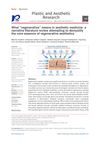
 February 2026 in “Plastic and Aesthetic Research”
 Regenerative aesthetic medicine aims to restore tissue function, but needs more consistent evidence and standardized practices.
Including ineffective or unsafe doses in reviews can lead to misleading conclusions about alopecia areata treatments.
 January 2026 in “Forum Dermatologicum”
 Hair loss can be caused by cancer, treatments, or skin conditions, and trichoscopy helps diagnose it.
 December 2025 in “International Neurourology Journal”
 Alpha-blockers and 5-alpha reductase inhibitors don't significantly increase dementia risk.
 December 2025 in “Universal library of medical and health sciences.”
 Amino acids like arginine and cysteine protect hair during chemical treatments, keeping it strong and less brittle.
 October 2025 in “Indian Journal of Dermatology Venereology and Leprology”
 Augmented virtual reality can help manage chronic skin conditions.
 October 2025 in “Turkish Journal of Biochemistry”
 Technological advancements and standardization are crucial for improving diagnostic accuracy and laboratory efficiency.
 July 2025 in “Berkala Ilmu Kesehatan Kulit dan Kelamin”
 Alopecia areata in children shows varied symptoms and may involve nails, needing further evaluation for other health issues.
Whiskers can form without sensory nerves or Foxd1, thanks to Meis2 in mesenchymal cells.
 March 2025 in “Texas Journal of Medical Science”
 Skin diseases affect young adults in India physically and emotionally.
 February 2025 in “Plastic and Aesthetic Research”
 Minoxidil and finasteride effectively promote hair regrowth within 3 months.
 February 2025 in “Revista Eletrônica Acervo Saúde”
 Thyroid tuberculosis can cause hypothyroidism and should be considered when diagnosing cervical masses.

New methods improve skin disease diagnosis and treatment.
 February 2025 in “Brazilian Journal of Hair Health”
 Multiparametric ultrasound effectively monitors scalp changes after using vasoconstrictive cosmetics.
 January 2025 in “International Journal For Multidisciplinary Research”
 Buddhist meditation techniques are better for reducing stress and anxiety than modern methods.
SL-HyDE improves medical information retrieval accuracy without needing labeled data.
Meis2 is essential for whisker development, independent of nerve involvement.
 September 2024 in “Cureus”
 Removing breast implants resolved the patient's symptoms.
 August 2024 in “Journal Integration of Social Studies and Business Development”
 Sassle's haircare business is financially viable and profitable.
 July 2024 in “Plastic and Aesthetic Research”
 Careful planning and accurate diagnosis are crucial for successful hair restoration surgery.

Sintilimab with chemotherapy improves survival and response in advanced lung cancer but increases some side effects.
 July 2024 in “International Journal of Dermatology Venereology and Leprosy Sciences”
 Trichoscopy is a useful, painless tool for diagnosing and monitoring children's hair and scalp issues.
Blocking the Mitochondrial Pyruvate Carrier causes stress in hair follicles, which can be reduced by an ISR inhibitor.
 June 2024 in “Research Square (Research Square)”
 Young women in West Bengal, India, with PCOS often have estrogen resistance, leptin receptor issues, folate deficiency, T2DM, and acanthosis, commonly linked to obesity.
The Chromolaena odorata patch significantly speeds up wound healing.
Early-onset baldness is linked to genetics, lifestyle, and can indicate higher risk for heart and metabolic diseases, and affects mental health.
 March 2024 in “Asian journal of medical sciences”
 Ring block anesthesia is the best method for PRP scalp injections due to low pain and high patient acceptance.
 February 2024 in “European heart journal. Case reports”
 Early surgical intervention and a multidisciplinary approach are crucial for managing complex cardio-obstetric patients.
 February 2024 in “Hormones”
 Future hormone therapy trials should match the diverse needs and priorities of the gender-diverse community.
 January 2024 in “Deleted Journal”
 Radiation cystitis patients need better monitoring and early treatment due to higher readmission rates.