May 2010 in “Faculty Opinions – Post-Publication Peer Review of the Biomedical Literature” A mutation in the KRT74 gene causes woolly hair by affecting hair texture.
 100 citations
,
June 2006 in “British Journal of Dermatology”
100 citations
,
June 2006 in “British Journal of Dermatology” Hair loss severity relates to increased miniaturization in female pattern hair loss.
 1 citations
,
June 2014 in “International Journal of Dermatology”
1 citations
,
June 2014 in “International Journal of Dermatology” Pregnancy can trigger follicular mucinosis, which may resolve after delivery.
130 citations
,
December 1998 in “The journal of investigative dermatology/Journal of investigative dermatology” Hair follicle melanocytes die during hair regression.
 8 citations
,
December 2009 in “Journal of The European Academy of Dermatology and Venereology”
8 citations
,
December 2009 in “Journal of The European Academy of Dermatology and Venereology” Researchers found a new mutation in the FERMT1 gene in a Spanish family with Kindler syndrome.
29 citations
,
January 2003 in “Genomics” A new mouse mutation causes skin and hair issues, influenced by another gene.
 13 citations
,
July 2012 in “Pigment Cell & Melanoma Research”
13 citations
,
July 2012 in “Pigment Cell & Melanoma Research” A mutation in the Adam10 gene causes freckle-like spots on Hairless mice.
 41 citations
,
November 2011 in “The Journal of Dermatology”
41 citations
,
November 2011 in “The Journal of Dermatology” Some hair loss disorders are caused by genetic mutations affecting hair growth.
 64 citations
,
August 2014 in “The journal of allergy and clinical immunology/Journal of allergy and clinical immunology/The journal of allergy and clinical immunology”
64 citations
,
August 2014 in “The journal of allergy and clinical immunology/Journal of allergy and clinical immunology/The journal of allergy and clinical immunology” A deficiency in the TTC7A gene causes immune problems, gut issues, and hair loss.
33 citations
,
July 2007 in “Journal of cell science” Miz1 is essential for proper hair structure and growth.
 November 2024 in “The Journal of Cell Biology”
 Basement membrane changes are crucial for hair follicle development.
2 citations
,
December 2023 in “International Journal of Dermatology” A unique type of hair loss mimics another condition but has minimal inflammation and specific immune cells present.
9 citations
,
December 2012 in “Indian Journal of Dermatology Venereology and Leprology” Two sisters had rare, widespread cysts and complete hair loss, suggesting a genetic link.
 1 citations
,
September 2020 in “Journal of Dermatological Science”
1 citations
,
September 2020 in “Journal of Dermatological Science” The gene LRRC15 is more active in balding areas of the scalp compared to non-balding areas.
50 citations
,
September 2009 in “Molecular Genetics and Metabolism” A new gene mutation causes vitamin D resistance and rickets, treatable with calcium therapy.
September 2011 in “Chinese Journal of Dermatology” A man's skin condition was misdiagnosed and later identified as a rare type of skin cancer, which did not improve with treatment.
 5 citations
,
September 1986 in “Pediatric Dermatology”
5 citations
,
September 1986 in “Pediatric Dermatology” A family showed a new condition with inherited hair loss and skin changes, possibly due to one genetic disorder.
11 citations
,
March 2021 in “Molecular Carcinogenesis” Twist1 is crucial for UVB-induced skin cancer development.
47 citations
,
February 1998 in “Journal of bone and mineral research” A specific gene mutation causes vitamin D-resistant rickets and hair loss.
 24 citations
,
November 2008 in “Arquivos Brasileiros de Endocrinologia & Metabologia”
24 citations
,
November 2008 in “Arquivos Brasileiros de Endocrinologia & Metabologia” Four patients with a type of rickets and hair loss had different mutations in their vitamin D receptor gene, causing it to not work properly.
 1 citations
,
January 2018 in “Journal of SAFOMS”
1 citations
,
January 2018 in “Journal of SAFOMS” A rare ovarian tumor can cause unusual male-like symptoms, but surgery usually leads to a good outcome.
December 2004 in “PLoS ONE” The Foxn1(-/-) phenotype disrupts hair growth and affects skin stem cells.
January 2005 in “Enlighten: Publications (The University of Glasgow)” Melanocyte pathology requires keratinocyte hyperplasia and regulation dysfunction.
 September 2023 in “Journal of the American Academy of Dermatology”
 Children with alopecia areata, especially with Down syndrome or thyroid issues, should be screened for thyroid disease.
 45 citations
,
July 2009 in “Journal of human genetics”
45 citations
,
July 2009 in “Journal of human genetics” A gene variation is linked to hair thickness in Asians.
 May 2024 in “Frontiers in medicine”
 A genetic mutation in the LIPH gene causes tightly curled hair that stops growing in some Japanese individuals.
1 citations
,
January 2007 in “The Internet Journal of Dermatology” A rare, harmless skin tumor was found on a man's nose.
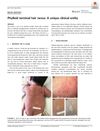 August 2018 in “Pediatric Dermatology”
 A baby had a unique skin condition with a pale patch and surrounding dark hairs, not linked to other health issues.
 1 citations
,
October 2022 in “JCI insight”
1 citations
,
October 2022 in “JCI insight” Deleting the BRD4 protein in certain skin cells causes hair loss and skin inflammation.
Loss of the p53 gene alone causes tumors, and losing both p53 and Rb genes speeds up aggressive skin cancer.