 19 citations
,
September 2016 in “Journal of the European Academy of Dermatology and Venereology”
19 citations
,
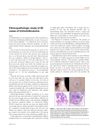
September 2016 in “Journal of the European Academy of Dermatology and Venereology” Trichofolliculoma is a unique benign tumor mainly affecting middle-aged adults' faces, often misdiagnosed without histopathology.
 April 2017 in “Journal of Investigative Dermatology”
 Removing the Crif1 gene in mouse skin disrupts skin balance and hair growth.
5 citations
,
March 2022 in “STAR Protocols” The method helps study hair follicle stem cells and calcium signals in mouse skin.
83 citations
,
May 2011 in “Experimental Dermatology” Sheep have 17 keratin genes, similar to humans, but with different expression patterns affecting wool and hair.
12 citations
,
June 2011 in “Journal of Dermatological Case Reports” Shaving, erythromycin cream, and clotrimazole powder effectively treated the bad odor and rough hair.
175 citations
,
August 1997 in “Nature Genetics” 78 citations
,
November 2005 in “Endocrinology” Hairless protein can block vitamin D activation in skin cells.
8 citations
,
August 1987 in “The Journal of Dermatology” BKN-1 antibody targets specific keratin in basal cell epithelioma and normal skin basal cells.
 29 citations
,
March 2008 in “Dermatologic Surgery”
29 citations
,
March 2008 in “Dermatologic Surgery” The Cross-section Trichometer is a new tool that can measure hair quantity and detect hair loss and growth.
17 citations
,
September 2009 in “British Journal of Dermatology” Fragile hair in children is rarely linked to trichothiodystrophy (TTD).
 11 citations
,
March 2001 in “Clinics in Dermatology”
11 citations
,
March 2001 in “Clinics in Dermatology” Hair microscopy is useful for diagnosing hair disorders, but clear definitions are needed for accurate genetic analysis.
June 2015 in “The American journal of dermatopathology/American journal of dermatopathology” The study found that a one-step antibody method is better than the LSAB method for accurately studying hair follicle structures without false positives.
January 2026 in “Clinical Case Reports” A 6-year-old girl had both monilethrix and trichorrhexis nodosa, causing brittle hair, with minimal improvement from treatment.
12 citations
,
June 2011 in “Journal of applied polymer science” L-phenylalanine and hydrolyzed eggwhite protein deeply penetrate human hair.
68 citations
,
August 2014 in “PeerJ” Human hair proteins vary by individual, body site, and ethnicity, useful for forensics.
 40 citations
,
April 2006 in “Journal of the European Academy of Dermatology and Venereology”
40 citations
,
April 2006 in “Journal of the European Academy of Dermatology and Venereology” The Trichoscan system was found to be inaccurate for measuring hair growth, needing better software to be useful.
 2 citations
,
July 2021 in “JAAD Case Reports”
2 citations
,
July 2021 in “JAAD Case Reports” Trichoscopy of the beard is useful for diagnosing frontal fibrosing alopecia in men.
 June 2023 in “Medeniyet medical journal”
 People with alopecia areata have similar retinal structures but thicker choroidal regions compared to those without the condition.
 2 citations
,
January 2015 in “Hair transplant forum international”
2 citations
,
January 2015 in “Hair transplant forum international” Using human recombinant hyaluronidase in donor strip harvesting may improve the procedure.
 6 citations
,
January 2015 in “Dermatology”
6 citations
,
January 2015 in “Dermatology” Trichoscopy helps diagnose hair and scalp problems but isn't always definitive and should be used with other methods.
 64 citations
,
June 2014 in “Journal of The American Academy of Dermatology”
64 citations
,
June 2014 in “Journal of The American Academy of Dermatology” Researchers found a white halo around hair in most patients with a specific type of hair loss, which helps in early diagnosis and treatment.
4 citations
,
October 2003 in “Annales de Génétique” A specific gene mutation causes different hair defects in Indian monilethrix families.
 April 2024 in “Journal of cosmetic dermatology”
 Children with alopecia areata have more exclamation mark hairs and fewer yellow dots than adults.
 10 citations
,
January 2015 in “Skin appendage disorders”
10 citations
,
January 2015 in “Skin appendage disorders” Low-cost videomicroscopes are not as reliable as standard videodermatoscopes for scalp examination due to lower image quality.
47 citations
,
February 2014 in “Journal of Cutaneous Pathology” Matrical tumors share a common growth mechanism involving the Wnt pathway and consistent PHLDA1 expression.
June 2020 in “Journal of Investigative Dermatology” Hair shaft malformation contributes to Central Centrifugal Cicatricial Alopecia.
1 citations
,
May 2024 in “Skin Appendage Disorders” Early diagnosis with trichoscopy can improve management and quality of life for CCCA patients.
 1 citations
,
April 2020 in “International Journal of Research in Dermatology”
1 citations
,
April 2020 in “International Journal of Research in Dermatology” Trichoscopy is a reliable method for diagnosing different types of hair loss.
1 citations
,
June 2025 in “Journal of Drugs in Dermatology” Better documentation of alopecia areata in Black individuals is needed to improve diagnosis.
November 2024 in “Archives of Dermatological Research”