48 citations
,
August 1998 in “Developmental Biology” Deleting part of a gene in mice causes wavy hair and high pup loss.
 6 citations
,
December 2004 in “Anais Brasileiros de Dermatologia”
6 citations
,
December 2004 in “Anais Brasileiros de Dermatologia” Some family members had a condition with both loose hair and unique eye changes, possibly indicating a new type of ectodermal dysplasia.
July 2022 in “Zenodo (CERN European Organization for Nuclear Research)” 
Telogen Effluvium causes increased hair shedding and can be challenging to diagnose and treat.
 January 2023 in “Skin appendage disorders”
 Two Hispanic women developed Plica neuropathica, a condition causing tangled hair, possibly due to hair damage and various risk factors.
September 2016 in “Journal of dermatological science” TSC2 is crucial for proper hair follicle development and patterning.
19 citations
,
July 2004 in “Australasian Journal of Dermatology” Her hair grew back normally after she stopped rubbing it.
 1 citations
,
October 2021 in “Australasian Journal of Dermatology”
1 citations
,
October 2021 in “Australasian Journal of Dermatology” The document's conclusion cannot be provided because the document is not available or cannot be understood.
2 citations
,
January 2018 in “Indian dermatology online journal” A homeopathic antidandruff shampoo caused severe hair matting in a girl.
January 2021 in “Skin Appendage Disorders” 2 citations
,
June 2010 in “Medicina de Familia SEMERGEN” The girl's "dandruff" was actually harmless hair casts, not a hygiene issue.
 January 2014 in “Springer eBooks”
 Chronic telogen effluvium is a condition where there is prolonged shedding of hair.
 January 2022 in “Acta dermatovenerologica Alpina, Pannonica et Adriatica (Tiskana izd.)”
 Uncombable hair syndrome causes frizzy hair and can affect the nervous system, eyes, and ears, often co-occurring with other hair, skin, nail, and teeth conditions, and is linked to three specific gene mutations.
24 citations
,
January 2018 in “Development” Frizzled 3 and Frizzled 6 together control the orientation of mouse hair follicles.
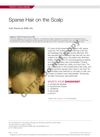
A 5-year-old girl has sparse, dry, and brittle hair but is otherwise healthy.
 15 citations
,
August 2015 in “Scanning”
15 citations
,
August 2015 in “Scanning” Corkscrew and cigarette-ash-shaped hairs in tinea capitis are caused by internal hair degradation and external resistance.
 4 citations
,
January 2014 in “Indian dermatology online journal”
4 citations
,
January 2014 in “Indian dermatology online journal” Monilethrix is a genetic hair disorder causing fragile, beaded hair with no effective treatment.
2 citations
,
October 2018 in “Skin appendage disorders” A boy's hair that was frizzy and hard to comb returned to normal after 9 months, possibly due to genetic factors.
53 citations
,
March 2006 in “Biopolymers” TTD hair is brittle due to fewer sulfur amino acids and unstable disulfide bonds.
 1 citations
,
July 2018 in “Elsevier eBooks”
1 citations
,
July 2018 in “Elsevier eBooks” Avoid chemical and physical damage to protect hair.
2 citations
,
July 2021 in “Actas dermo-sifiliográficas/Actas dermo-sifiliográficas” Hair shaft disorders are diagnosed through examination and history, with general care and some treatments offering improvement.
8 citations
,
June 2020 in “The journal of investigative dermatology/Journal of investigative dermatology” A boy's skin fragility and sparse hair were caused by a genetic mutation affecting skin cell adhesion.
101 citations
,
July 1985 in “Journal of the American Academy of Dermatology” Biotin improved hair growth and combability in one child with uncombable hair syndrome.
1 citations
,
May 2024 in “Communications Biology” Dab2 protein is crucial for hair follicle stem cell renewal and preventing early aging.
September 2021 in “CRC Press eBooks” Traumatic alopecia causes hair loss from pulling or rubbing, leading to broken hairs and changes in the scalp.
 15 citations
,
December 2014 in “PLoS ONE”
15 citations
,
December 2014 in “PLoS ONE” A mutation in the iRhom2 gene causes hairless mice due to abnormal hair follicle development.
 January 2021 in “Nasza Dermatologia Online”
 Plica polonica is a rare condition where hair becomes irreversibly tangled, and the treatment is to cut the matted hair.
December 2025 in “ILDS-DEV” 23 citations
,
July 2016 in “JAMA Ophthalmology” CDH3-related disease causes worsening eye and hair issues.
33 citations
,
September 1987 in “American Journal of Medical Genetics” Uncombable hair is inherited dominantly with complete penetrance.