 1 citations
,
January 1998 in “Seminars in Plastic Surgery”
1 citations
,
January 1998 in “Seminars in Plastic Surgery” Hair transplantation using micro- and minigraft megasessions is safe, effective, and provides natural results with high patient satisfaction.
 December 2023 in “Facial Plastic Surgery”
 Surgeons should be careful with FUE hair transplants to avoid negative effects on the donor area's appearance and ensure good cosmetic results.
 November 2023 in “Facial Plastic Surgery”
 Follicular Unit Excision (FUE) is a popular, less invasive hair restoration method with high patient satisfaction when done correctly, despite some complications from untrained practitioners.
 November 2023 in “Pakistan Journal of Medical & Health Sciences”
 Careful technique and planning lead to successful, natural-looking eyebrow transplants.
 September 2023 in “Hair transplant forum international”
 Hair transplants are generally satisfying and successful, but transplanted hair can thin over time.
 May 2023 in “Aesthetic Plastic Surgery”
 The document concludes that there are various surgical techniques for hair restoration, their success depends on the surgeon's skill, patient's health, and quality of donor hair, and they can potentially improve the mental well-being of those with hair loss.
January 2022 in “Zenodo (CERN European Organization for Nuclear Research)” Female hair transplants are popular for restoring hair in women with genetic hair loss, but they are costly and not suitable for everyone.
 March 2021 in “Journal of Maxillofacial and Oral Surgery”
 Beard hair can be used for hair transplants in severe alopecia cases, with minimal complications and good results.
 November 2018 in “Springer eBooks”
 The document concludes that specialized hair transplant techniques can be effective, with varying success rates depending on the donor area and patient factors.
 July 2015 in “DOAJ (DOAJ: Directory of Open Access Journals)”
 Hair transplant surgery can provide natural-looking results for hair loss, but challenges include limited donor hair, hair survival, and hiding signs of surgery.
 July 2008 in “Expert Review of Dermatology”
 Proper planning for hair transplants is crucial for natural results, with careful patient selection and strategic graft placement being key factors.
 November 2002 in “Dermatologic Surgery”
 Scalp reduction gives the most natural result for significant crown baldness, despite potential complications, and a systematic approach to surgical hair restoration results in few complications and high graft survival.
 September 2002 in “Dermatologic Surgery”
 The recipient site can affect the growth and survival of transplanted hair but not its thickness.
 May 1993 in “Medical Clinics of North America”
 Surgical hair replacement is a viable option for male pattern baldness when done with proper planning and realistic expectations.
 January 2024 in “Advances in Cosmetic Surgery”
 Robotic hair restoration is a safe, efficient alternative to manual hair transplant, best for men with dark, thick hair and skin, requiring sufficient donor hair and postoperative care.
 December 2023 in “Facial Plastic Surgery”
 Follicular unit excision (FUE) is a popular hair transplant method that avoids a linear scar but has potential challenges and side effects if not done properly.
October 2022 in “Hair Transplantation” Successful hair transplants need enough donor hair and careful planning.
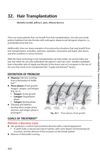 January 2018 in “Georg Thieme Verlag eBooks”
 Hair transplantation is a surgical procedure to move hair to bald areas, requires good donor hair, and results show in about a year.

The document provides a step-by-step training guide for beginner surgeons and assistants to learn hair restoration surgery, emphasizing careful practice to avoid irreversible loss of hair follicles.
 September 2017 in “Indian Journal of Plastic Surgery”
 Garg and Garg created an affordable, easy-to-use training program for hair restoration surgery using everyday items, which can teach a technician the basics in 3-4 weeks with two hours of daily practice.
Transplanting beard hair into a scalp wound after hair transplant surgery improves scar appearance and hair keeps its normal traits.
 January 2016 in “Georg Thieme Verlag eBooks”
 Hair transplantation in East Asians needs special techniques to ensure natural results and prevent complications due to their unique hair and scalp characteristics.
 October 2015 in “Journal of Bioresource Management”
 Growing hair cells in the lab from plucked hairs could lead to a new, less invasive, and cheaper baldness treatment.
 January 2013 in “Hair transplant forum international”
 Both surgical hairline advancement and follicular unit transplantation effectively lower the female hairline, but they differ in speed, scarring, and naturalness of results.

Hair transplants can cause hair loss if done while lichen planopilaris is active; wait until it's inactive for two years and check with a scalp biopsy first.
January 2004 in “Chinese Journal of Medical Aesthetics and Cosmetology” Hair transplantation is effective for seborrheic hair loss if done carefully.
 October 2002 in “Dermatologic Surgery”
 The document concludes that careful planning, efficient use of every hair graft, and setting surgical priorities are crucial for successful hair restoration surgery.
 October 2001 in “Dermatologic Surgery”
 Cutting and implanting hair follicles can create finer, more natural-looking hairlines, with about half of the implanted hairs growing back.
 August 1998 in “Dermatologic Surgery”
 Dr. George A. Farber recommends using follicular unit transplantation for hair restoration because it gives a more natural look and has fewer problems compared to the older miniflap technique.
 June 1997 in “The American Journal of Cosmetic Surgery”
 Reharvesting hair from donor sites using punch and strip methods can provide more hair for transplants and improve scar appearance.