Search
for
Sort by
Research
360-390 / 1000+ results
research The boosting effect of minoxidil 0.1% when combined with dutasteride 0.01% and microneedling in the treatment of female pattern hair loss
Combining minoxidil with dutasteride and microneedling is more effective for female pattern hair loss than just dutasteride and microneedling.
research Hypertrichosis in females applying minoxidil topical solution and in normal controls
Minoxidil use increases facial hair growth in females, more in older users.
research Minoxidil and male-pattern alopecia: a potential role for a local regulator of sebum secretion with vasoconstrictive effects?
Minoxidil, a common hair loss treatment, might work by counteracting a hormone that reduces hair growth and promotes hair loss.
research Topically Applied Minoxidil in Baldness
Minoxidil, when applied to the scalp, can stimulate hair growth but effects vary, stop if treatment ends, and it may cause side effects like fluid retention.
research Use of topical minoxidil in the treatment of male pattern baldness
Minoxidil effectively regrows hair in male pattern baldness.
research Topical minoxidil in androgenetic alopecia, how good is it ?
research Uso de minoxidil no tratamento de alopecia de padrão feminino: revisão sistemática
Minoxidil can treat female hair loss but may cause side effects.
research Minoxidil: right atrial cardiac pathology in animals and in man.
Minoxidil may cause heart issues in animals and humans.
research Rapid Blood Pressure Control With Minoxidil
Minoxidil effectively lowers blood pressure and initially increases plasma renin activity without raising aldosterone levels.
research MINOXIDIL-HAEMODYNAMIC AND CLINICAL EXPERIENCES WITH A NEW PERIPHERAL VASODILATOR
Minoxidil helps control blood pressure but has side-effects, so it's not for everyone.
research Scalp vascularization as a marker of topical minoxidil treatment efficacy in patients with androgenetic alopecia
Minoxidil works equally well for hair growth regardless of scalp blood flow.
research A randomized controlled, single-observer blinded study to determine the efficacy of topical minoxidil plus microneedling versus topical minoxidil alone in the treatment of androgenetic alopecia
Combining microneedling with minoxidil is more effective for hair growth than using minoxidil alone.
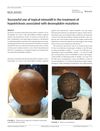
research Successful use of topical minoxidil in the treatment of hypotrichosis associated with desmoplakin mutations
Topical minoxidil helped an 8-year-old boy with a genetic hair disorder grow hair.
research Hair Sciences: The value of cooperation with hair biologists: How does minoxidil stimulate hair growth?
Minoxidil helps hair grow by opening specific channels in hair follicles.

research Comparative Efficacy of Minoxidil and 5‐Alpha Reductase Inhibitors Monotherapy for Male Pattern Hair Loss: Network Meta‐Analysis Study of Current Empirical Evidence
Dutasteride 0.5 mg/day is the most effective treatment for male pattern hair loss.
research Tolerance and safety profile of sublingual minoxidil in the treatment of androgenic alopecia
Sublingual minoxidil is a safe and effective treatment for hair loss, especially in women.
research Topical Minoxidil
Minoxidil promotes hair regrowth, but more research needed for effectiveness and response factors.
research A COMBINATION STUDY BETWEEN TOPICAL 5%MINOXIDIL AND TOPICAL PROCAPIL IN MEN WITH ANDROGENIC ALOPECIA
Combining Procapil with minoxidil improves hair growth in men with hair loss.
research A COMBINATION STUDY BETWEEN TOPICAL 5%MINOXIDIL AND TOPICAL PROCAPIL IN MEN WITH ANDROGENIC ALOPECIA
Combining Procapil with minoxidil improves hair growth in men with hair loss.
research Hair Follicle Biology and Topical Minoxidil: Possible Mechanisms of Action
Minoxidil stimulates hair growth by increasing hair thickness and prolonging growth phase.
research Scalp comedones after topical minoxidil
Minoxidil can cause scalp comedones and acne.

research Low-dose oral minoxidil improves hair length and global hair density in short anagen syndrome
Low-dose minoxidil helps hair grow longer and thicker in people with short anagen syndrome.
research Relative efficacy of minoxidil and 5-alpha-reductase inhibitors in the treatment of male androgenetic alopecia: protocol for a network meta-analysis study
research ENHANCED IN VITRO HAIR GROWTH AT THE AIR-LIQUID MINOXIDIL PRESERVES THE ROOT SHEATH IN CULTURED WHISKER FOLLICLES INTERFACE:
Culturing hair follicles at the air-liquid interface with minoxidil significantly boosts hair growth and preserves the root sheath.
research Topical minoxidil in alopecia areata
Minoxidil helps hair regrowth in alopecia areata safely.

research Comparison between “5% minoxidil plus 2% flutamide” solution vs. “5% minoxidil” solution in the treatment of androgenetic alopecia
Using both minoxidil and flutamide together is more effective for treating hair loss than using minoxidil alone.
research ▾Topical minoxidil does little for baldness
Topical minoxidil is not very effective for baldness.

research [Treatment of androgenic alopecia with minoxidil].
Minoxidil is used to treat hair loss.