10 citations
,
January 2004 in “PubMed” Radiation increases cell death in hair follicles, but certain treatments can protect against this effect.
2 citations
,
January 1981 High temperatures and certain chemicals can significantly change the amino acid content in human hair.
Trichopigmentation is a non-invasive, reversible treatment for hair loss that offers natural-looking results for both men and women.
Using aluminum foil for hair bleaching gives better copper blonde color.
1 citations
,
February 1989 in “PubMed” Electrophoresis can effectively analyze hair proteins for forensic use, even after cosmetic treatments and up to 2 years of weathering.
 July 2018 in “Elsevier eBooks”
 Some drugs can cause reversible hair loss, but certain chemotherapy drugs may lead to permanent hair loss; drugs can also change hair color and texture.
1 citations
,
April 2001 in “Biological Rhythm Research” Deuterium oxide extends the hair cycle duration in mice without changing hair structure.
 13 citations
,
June 2021 in “Carcinogenesis”
13 citations
,
June 2021 in “Carcinogenesis” Certain hair straighteners and dyes may increase ovarian cancer risk, especially in African American/Black women.
15 citations
,
January 1989 in “European Journal of Cancer and Clinical Oncology” July 2019 in “Indian dermatology online journal” Alopecia areata can show unusual red-dotted vessels and dithranol treatment may mask typical patterns.
 June 2025 in “BMJ Case Reports”
 Axitinib treatment turned a man's grey hair back to black.
 2 citations
,
March 2023 in “JAAD case reports”
2 citations
,
March 2023 in “JAAD case reports” Hair repigmentation can indicate malignancy and should be investigated.
 March 2013 in “Molecular & Cellular Toxicology/Molecular & cellular toxicology”
 m-Aminophenol in hair dye can cause skin cell toxicity and stress responses.
48 citations
,
September 2010 in “PubMed” Chemotherapy often causes hair loss, which is distressing for many, but usually reversible.
10 citations
,
January 2015 in “Current problems in dermatology” Gentle hair care and avoiding harsh treatments can help manage hair loss.
 8 citations
,
February 2005 in “British Journal of Haematology”
8 citations
,
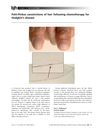
February 2005 in “British Journal of Haematology” Chemotherapy caused the patient's hair to have alternating thick and thin segments.
November 2020 in “Zenodo (CERN European Organization for Nuclear Research)” Managing stress and avoiding hair dyes can help prevent hair loss.
 December 1990 in “PubMed”
 Some drugs can cause hair loss, increase hair growth, or change hair color, but stopping the drug usually reverses these effects.
Dark hair with a red beard likely evolved for camouflage, not attraction.
March 2020 in “Journal of Burn Care & Research” Hair highlighting can cause severe scalp burns, and surgery with psychological support improves recovery.
 9 citations
,
June 1959 in “Archives of dermatology”
9 citations
,
June 1959 in “Archives of dermatology” Hair can darken after inflammation and then return to its original color.
September 2022 in “World Journal of Advanced Research and Reviews” Adjust the Airtouch technique based on hair density for best coloring results.
 8 citations
,
January 2018 in “European journal of dermatology/EJD. European journal of dermatology”
8 citations
,
January 2018 in “European journal of dermatology/EJD. European journal of dermatology” The girl's regrown brown hair had less of certain pigments than her original black hair.
research Hair
3 citations
,
January 2014 in “Elsevier eBooks” Hair can reveal toxic elements and drugs in the body.
 July 2002 in “Dermatologic Surgery”
 Some people's hair turned white or gray after using intense pulsed light for hair removal, and for some, it was permanent.
 March 2024 in “Jurnal Tata Rias”
 Ginger hair tonic can reduce hair loss and improve hair quality.
 2 citations
,
January 2014 in “Sen i Gakkaishi”
2 citations
,
January 2014 in “Sen i Gakkaishi” The new hair straightening method keeps hair straight permanently by using specific creams and heat.
 4 citations
,
February 2025 in “Clinical Cosmetic and Investigational Dermatology”
4 citations
,
February 2025 in “Clinical Cosmetic and Investigational Dermatology” Hair affects self-image and well-being, varying by gender, ethnicity, and country.
15 citations
,
January 2017 in “Pigment International” Early hair graying is often inherited and influenced by genetics, environment, and lifestyle, but treatment options are limited.