Search
for
Sort by
Research
840-870 / 1000+ resultsresearch Nε-(carboxymethyl) lysine (CML) inhibits hair follicle formation by suppressing hair bulb condensation

research 1339 Casein kinase 1 inhibition in keratinocytes enhances the migration of melanocyte precursors in the hair follicle via KitL/c-Kit signaling pathway
Blocking casein kinase 1 in skin cells can help melanocyte precursors move better, potentially helping with conditions like vitiligo or gray hair.
research Mice Expressing a Mutant Krt75 (K6hf) Allele Develop Hair and Nail Defects Resembling Pachyonychia Congenita

research Intradermal Injection of Bleomycin Shows Preliminary Evidence of Dermal Fibrosis in a Mouse Model
Bleomycin injections in mice cause skin thickening and hair loss.
research Differences in activation of β-catenin in outer root sheath cells between the type of JAK inhibitor: An alternative mechanism promoting hair growth by JAK inhibitors in alopecia areata

research Human hair follicles operate an internal Cori cycle and modulate their growth via glycogen phosphorylase
Inhibiting glycogen metabolism can promote hair growth.

research Histopathological and Ultrastructural Study of Ectodermal Dysplasia/Skin Fragility Syndrome
The study concluded that PKP1 is essential for skin integrity and hair growth, and its dysfunction causes the symptoms of ectodermal dysplasia/skin fragility syndrome.
research Retardation of Hair Follicle Development by the Deletion of TrkC, High-Affinity Neurotrophin-3 Receptor
Lack of TrkC receptor delays hair follicle development.
research Fast-Embeddable Grooved Microneedles by Shear Actuation for Accurate Transdermal Drug Delivery
New microneedles deliver drugs through the skin accurately and effectively.
research Generalized trichorrhexis nodosa
The hair disorder was caused by abnormal protein formation, making hair easily damaged.
research Hypohidrotic Ectodermal Dysplasia with c.28delG Mutation in Ectodysplasin A Gene and Severe Atopic Dermatitis Treated Successfully with Tofacitinib
Tofacitinib effectively improved severe skin symptoms in a patient with Hypohidrotic Ectodermal Dysplasia.

research pH Dependence of the Coiled-Coil Structure of Keratin Intermediate Filament in Human Hair by 13C NMR Spectroscopy and the Mechanism of Its Disruption
Keratin structure in hair is stable at pH 5-6 but disrupts between pH 6-7.

research Mutations in the Keratin 85 (KRT85/hHb5) Gene Underlie Pure Hair and Nail Ectodermal Dysplasia
Mutations in the KRT85 gene cause hair and nail problems.
research Krtap16, Characterization of a New Hair Keratin-associated Protein (KAP) Gene Complex on Mouse Chromosome 16 and Evidence for Regulation by Hoxc13
Hoxc13 regulates specific hair protein genes on mouse chromosome 16.
research Change in Hair Cycle and Hair Length in Nude Mice by Administration of Deuterium Oxide
Deuterium oxide extends the hair cycle duration in mice without changing hair structure.
research Profibrotic Molecules Are Reduced in CRISPR-Edited Emery–Dreifuss Muscular Dystrophy Fibroblasts
CRISPR gene editing reduces harmful molecules in cells from Emery–Dreifuss Muscular Dystrophy patients.

research MAD2B acts as a negative regulatory partner of TCF4 on proliferation in human dermal papilla cells
MAD2B slows down the growth of skin cells that are important for hair development by interacting with TCF4.

research 5alpha-reductase inhibitors dampen L-DOPA-induced dyskinesia via normalization of dopamine D1-receptor signaling pathway and D1-D3 receptor interaction
Finasteride and dutasteride reduce unwanted movements from Parkinson's disease treatment by normalizing certain brain signals.

research Structural and biochemical changes underlying a keratoderma-like phenotype in mice lacking suprabasal AP1 transcription factor function
Inhibiting AP1 in mice skin causes structural changes and weakens the skin barrier.

research Nano-spanlastics-loaded dissolving microneedle patches for ketotifen fumarate: advanced strategies for allergic conjunctivitis treatment and molecular insights
The microneedle patches effectively treat allergic conjunctivitis with controlled, sustained release of medication.
research Harnessing the Biomimetic Effect of Macromolecular Crowding in the Cell-Derived Model of Clubfoot Fibrosis
The model helps test drugs for clubfoot fibrosis by mimicking cell environments and shows minoxidil reduces harmful collagen links.
research Three-Dimensional Morphology of Touch Domes in Human Hairy Skin by Correlative Light and Scanning Electron Microscopy
Touch domes in human skin are complex sensory structures not directly linked to hair.
research Histological and dermatoscopic description of sphynx cat skin
Sphynx cats have abnormal hair follicles and keratinization affecting their skin.
research Exploring a biological tissue from atomic to macroscopic scale using synchrotron radiation: example of hair.
Hair has unevenly distributed proteins and lipids, with lipids mainly in the cuticle and proteins in the cortex and medulla.

research An optimized force-triggered density gradient sedimentation method for isolation of pelage follicle dermal papilla cells from neonatal mouse skin
New method efficiently isolates hair growth cells from newborn mouse skin.
research Dermoscopy: A rapid bedside tool to assess monilethrix
Dermoscopy quickly and accurately diagnosed a rare hair disorder in a 12-year-old girl.
research Synthesis and biological evaluation of dimeric peptide derivatives as proliferation‐stimulating agents in human follicle dermal papilla cells
Dimeric peptide derivatives could help hair growth and treat hair loss safely.
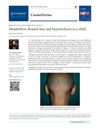
research Monilethrix: Beaded hair and hypotrichosis in a child
A 9-year-old girl has a rare hair disorder causing beaded, sparse hair.

research 570 DNA dioxygenases Tet1/2/3 control cell differentiation in the hair follicle keratinocytes via modulating the activity of BMP signaling pathway
Tet1/2/3 enzymes affect hair follicle cell development by influencing BMP signaling.