52 citations
,
February 2012 in “PloS one” Lack of Ctip2 in skin cells delays wound healing and disrupts hair follicle stem cell markers in mice.
15 citations
,
January 1996 in “Adelaide Research & Scholarship (AR&S) (University of Adelaide)” Keratin gene regulation was emerging, with a key transcription factor found to influence hair growth and gene expression.
3 citations
,
September 2023 in “Genes” Dkk genes evolved faster in birds and reptiles, affecting hair development functions.
 April 2017 in “Journal of Investigative Dermatology”
 Removing the Crif1 gene in mouse skin disrupts skin balance and hair growth.
 6 citations
,
January 2020 in “Czech Journal of Animal Science”
6 citations
,
January 2020 in “Czech Journal of Animal Science” The FAT1 gene and its variations can help improve wool quality in Chinese Merino sheep through selective breeding.
1 citations
,
August 2013 in “The Journal of Cell Biology” Lack of Evi in skin causes psoriasis-like symptoms in mice.
28 citations
,
July 1993 in “The journal of investigative dermatology/Journal of investigative dermatology” 43 citations
,
April 1996 in “Journal of Investigative Dermatology”  May 2023 in “The journal of investigative dermatology/Journal of investigative dermatology”
 EAAT4 decreases with age, harming skin function and calcium balance.
97 citations
,
June 2013 in “Journal of Dermatological Science” Understanding EGFR's role in skin is crucial for better treatments and managing side effects.
 April 2017 in “Journal of Investigative Dermatology”
 Targeted siRNA therapy may be a promising treatment for KID syndrome by reducing mutant gene expression and improving cell communication.
 1 citations
,
August 2018 in “bioRxiv (Cold Spring Harbor Laboratory)”
1 citations
,
August 2018 in “bioRxiv (Cold Spring Harbor Laboratory)” A new mutation in the TMEM173 gene and a risk allele in IFIH1 cause a unique set of immune-related symptoms.
21 citations
,
January 1995 in “Molecular Biology Reports” Scientists discovered two versions of a new human hair keratin gene.
6 citations
,
February 2024 in “Pharmaceutics” ELIP-based CRISPR delivery improves heart disease gene editing but needs more testing.
 March 2023 in “JAAD case reports”
 A new genetic change in the keratin 10 gene caused a skin condition called ichthyosis hystrix in a father and his daughter.
 13 citations
,
February 2007 in “British Journal of Dermatology”
13 citations
,
February 2007 in “British Journal of Dermatology” EF and PXE not closely related.
 February 2025 in “Journal of Investigative Dermatology”
 The ZIP13 variant is linked to abnormal hair quality.
14 citations
,
May 2017 in “Journal of Investigative Dermatology” A rare gene mutation causes skin fragility and itching without affecting hair or nails.
67 citations
,
January 1992 in “Journal of Investigative Dermatology”  1 citations
,
April 2023 in “Science Advances”
1 citations
,
April 2023 in “Science Advances” High levels of ERK activity are key for tissue regeneration in spiny mice, and activating ERK can potentially redirect scar-forming healing towards regenerative healing in mammals.
 January 2018 in “bioRxiv (Cold Spring Harbor Laboratory)”
 Researchers found key regions in the mouse hairless gene that control its activity in skin and brain cells, affecting hair follicle function.
 195 citations
,
February 2005 in “Journal of biological chemistry/The Journal of biological chemistry”
195 citations
,
February 2005 in “Journal of biological chemistry/The Journal of biological chemistry” The ZIP7 gene helps control zinc levels in cells by moving zinc from the Golgi apparatus to the cytoplasm.
8 citations
,
October 2012 in “Transgenic Research” Overexpressing the human H-ferritin gene in mice causes mild growth delay and temporary hair loss.
27 citations
,
April 2004 in “Biochemical and Biophysical Research Communications” Two new gene clusters important for hair formation were found on human chromosome 11.
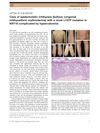 October 2011 in “Journal of dermatology”
 A man with a rare skin condition and a new gene mutation developed high calcium levels due to his treatment.
 38 citations
,
February 2012 in “British Journal of Dermatology”
38 citations
,
February 2012 in “British Journal of Dermatology” AR/EDA2R gene linked to early-onset female hair loss, but 20p11 gene not involved.
 18 citations
,
August 2018 in “The FASEB journal”
18 citations
,
August 2018 in “The FASEB journal” Rabbits lacking the Hoxc13 gene show similar hair and skin issues to humans with ECTD-9, making them good for research on this condition.
 1 citations
,
September 2019 in “Journal of Investigative Dermatology”
1 citations
,
September 2019 in “Journal of Investigative Dermatology” The research showed that CRISPR/Cas9 can fix mutations causing a skin disease in stem cells, which then improved skin grafts in mice, but more work on safety and efficiency is needed.
 16 citations
,
October 2014 in “Cell death and disease”
16 citations
,
October 2014 in “Cell death and disease” FoxN1 overexpression in young mice harms immune cell and skin development.
 10 citations
,
November 2018 in “Genetics in medicine”
10 citations
,
November 2018 in “Genetics in medicine” Lack of cystatin M/E causes thin hair and dry skin.